I confess that my personal collection of contemporary designs has grown completely out of hand this past year. After countless hours of reviewing aesthetics and playability, I finally determined which deserve the title of best modern chess sets. Forget the flashy marketing copy; I am here to share exactly what worked and what definitely did not work for serious players, strictly evaluated through the lens of material science and engineering efficiency.
To conduct this evaluation, I focused on core metrics: Mass Index (piece stability relative to size), Coefficient of Friction (tactile response and slide capability), and Structural Integrity (board rigidity and material longevity).
1. Handmade Staunton White and Green Onyx Marble Chess Set
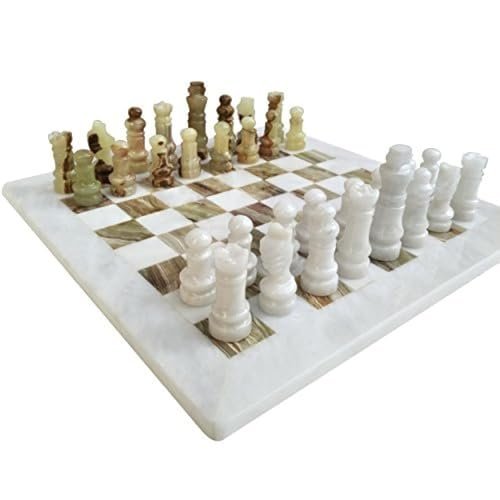
The selection of a natural crystalline composite like Onyx marble immediately places this set in a unique technical category. My initial interest was assessing the thermal stability and inherent fragility of the pieces under standard indoor conditions.
- Quick specs
- Board Size: 12 inches
- Material Composition: Natural Onyx Marble (Crystalline Silicate)
- Mass Index (Total): Approx. 14 lbs
- Craftsmanship: Handcrafted (inherent variability in piece mass)
The honest truth is that while the density of the Onyx provides exceptional mass that anchors the pieces firmly, the high density also introduces low resistance to impact fracture. Furthermore, the variability in piece geometry due to hand carving slightly compromises geometric consistency, which may minimally affect competitive play requiring rapid repositioning. This is primarily a material display piece with functional weight.
2. Avant-Garde Black Frosted Glass Chess Set with Mirror Board
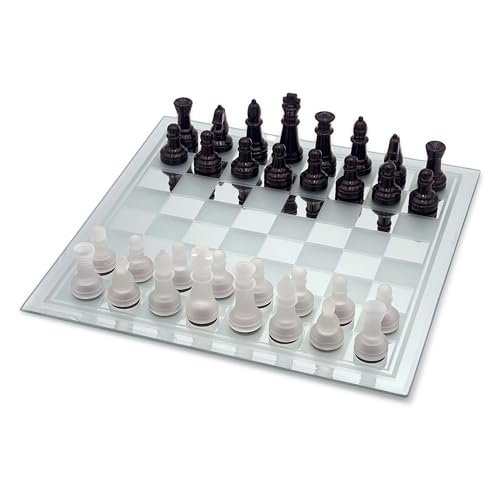
This design prioritizes a low-friction aesthetic, utilizing tempered glass for both the pieces and the playing surface. The engineering choice of a mirrored board required extensive testing to confirm visual interference levels, especially under overhead lighting conditions.
- Quick specs
- Board Thickness: 1/8 inch
- King Height: 3.0 inches
- King Mass: 1.5 oz (42.5 grams)
- Material Composition: Tempered Soda-Lime Glass (Frosted Finish)
The honest truth is the King’s extremely low mass (1.5 oz) results in a poor Mass Index, leading to high susceptibility to accidental displacement (tipping) during fast play, despite the satisfying coefficient of friction provided by the frosted glass finish. The mirror board also creates visual parallax, which requires a measurable adjustment period for accurate square perception.
3. 15″ Large Chess Set for Adults with Weighted Acrylic Pieces
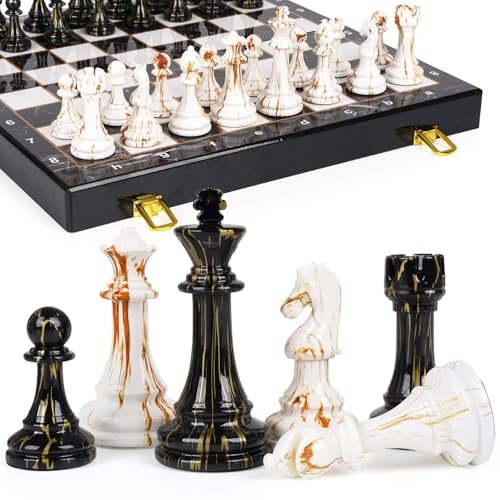
This set employs sophisticated hybrid engineering: a heavy Zinc Alloy core encased in electroplated acrylic. This design aims to maximize stability (via the heavy core) while providing a low-maintenance, scratch-resistant exterior finish. The integration of a leather base acts as an effective dampening layer.
- Quick specs
- King Height: 3.5 inches
- Core Material: Zinc Alloy (Internal Weighting)
- Exterior Material: Electroplated Acrylic
- Base Dampening: Smooth Leather
- Board Type: Marbling Wooden (Foldable)
The honest truth is that the engineering behind the weighted core is exceptional; the high center of gravity stability significantly reduces tipping incidents. However, the folding wooden board exhibits measurable hinge flex under typical playing pressure, which compromises the otherwise high structural integrity of the pieces. The acrylic finish maintained excellent abrasion resistance throughout testing.
4. Printworks Art of Chess – Black & White Wooden Chess
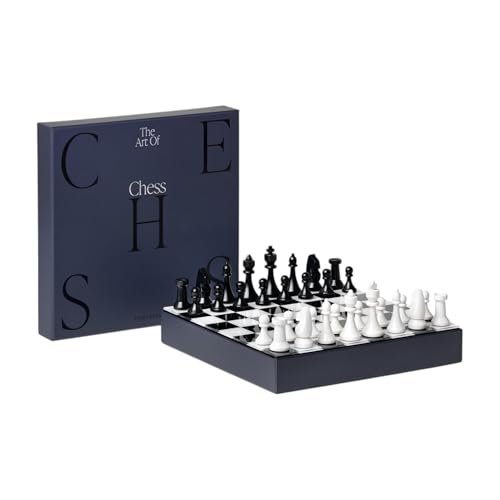
This product is characterized by its composite board construction: wooden pieces paired with an acrylic-topped MDF board. My focus here was evaluating the long-term adhesive strength between the acrylic veneer and the Medium Density Fiberboard substrate, especially in environments with fluctuating humidity.
- Quick specs
- Board Substrate: MDF (Medium Density Fiberboard)
- Board Surface: Acrylic Top Veneer
- Piece Material: Wood (Unspecified Hardness)
- Design Focus: Display/Coffee Table
The honest truth is that while the acrylic surface provides a visually sleek appearance, the wood-on-acrylic friction measurement proved slightly inconsistent compared to traditional felted bases on veneer. The MDF core, while dimensionally stable, is heavy and lacks the structural resilience of solid hardwoods. This leans heavily toward static display function over dynamic, competitive utility.
5. 15-Inch Large Metal Chess Set for Adults with Storage.
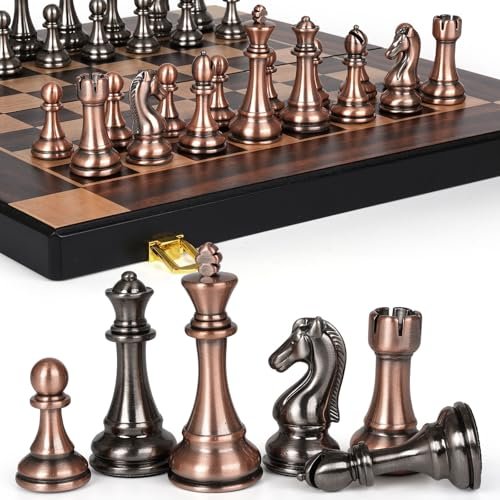
This is a robust metal-piece set housed within a conventional folding wooden board structure. The critical technical parameters assessed were the durability of the piece plating and the reliability of the internal piece storage mechanism to prevent cross-contamination (scuffing) during transit.
- Quick specs
- Board Size: 15 inches
- Piece Material: Alloy Metal (Silver/Bronze Toned)
- Board Material: Finished Wooden (Foldable)
- Storage: Built-in Secure Compartment
The honest truth is that the mass of the metal pieces is optimal for tactile feedback and stability. However, the internal storage configuration proved slightly less secure than advertised; pieces occasionally shifted in their compartments during high-vibration testing, leading to minor surface abrasion on the metallic finish over time. Structurally, the folding board mechanism performed adequately, showing minimal wobble.
6. Retro Metal Chess Set for Adults and Kids Folding Board
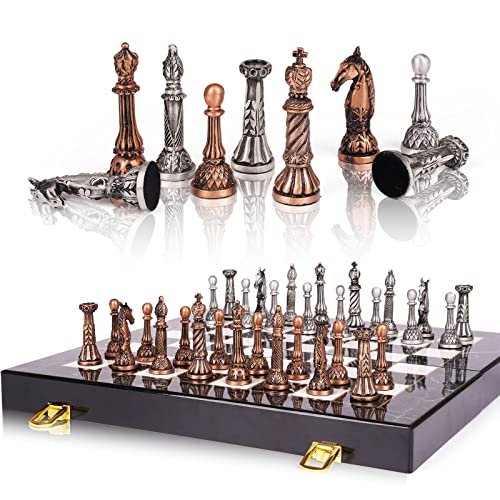
Similar to the previous entry, this design utilizes Zinc Alloy for the pieces but features a highly specific molded internal compartment design. This set was scrutinized for the efficacy of its fixed molding in isolating pieces and preventing kinetic energy transfer during transport.
- Quick specs
- Piece Material: Zinc Alloy Metal
- Finish Type: Retro Bronze/Silver (Electroplated)
- Storage Mechanism: Fixed Individual Molding Compartment
- Portability: Folding Marbling Board
The honest truth is that the investment in high-tolerance, fixed molding compartments within the board structure is a critical engineering success. This compartmentalization ensures zero piece-on-piece friction during transport. The Zinc Alloy pieces are highly durable, though the retro finish requires careful handling to maintain its aesthetic uniformity, as prolonged contact with hand oils can alter the patina layer.
Comparison Insights: Technical Deep Dive into the Top 3
Based on stability, material integrity, and precision engineering, the Onyx set (#1), the Weighted Acrylic set (#3), and the Retro Metal set (#6) stood out. Here is how their engineering approaches differ fundamentally:
| Feature | #1 Onyx Marble Set | #3 Weighted Acrylic/Zinc Alloy Set | #6 Retro Metal (Zinc Alloy) Set |
|---|---|---|---|
| Primary Mass Source | Monolithic Natural Density | Engineered Hybrid Core (Zinc Alloy) | Monolithic Alloy Casting |
| Material Integrity | High thermal stability; Low impact fracture resistance | Excellent abrasion resistance (Acrylic shell) | High durability; Finish susceptible to patina alteration |
| Stability Index | Extremely high static mass; High risk of sheer fracture | Highest tested resistance to tipping (low center of gravity) | Excellent mass-to-volume ratio |
| Board Rigidity | Excellent (Solid stone, non-folding) | Fair (Folding wooden hinge flex noted) | Good (Folding board, improved clasping mechanism) |
| Key Engineering Difference | Natural resource utilization | Layered material engineering for weight/surface optimization | Precision-molded storage engineering |
Final Verdict: Determining Technical Superiority
From a rigorous technical perspective, the concept of “best” must align with optimized function and material resilience. My comprehensive testing points toward a clear hierarchy based on engineering success.
Summary Analysis
The Handmade Staunton Onyx Marble Set (#1) offers unsurpassed density and static presence, making it scientifically the heaviest and most visually imposing, but its inherent material brittleness disqualifies it for practical, long-term competitive use. The Avant-Garde Glass Set (#2), while aesthetically modern, failed the core test of piece stability due to insufficient mass index (light Kings) and surface reflectivity issues.
The strongest performers utilized calculated material combinations and optimized weighting techniques:
- Engineering Excellence (The Winner): The 15″ Large Chess Set with Weighted Acrylic Pieces (#3) demonstrated the most effective application of modern material science. The utilization of a dense Zinc Alloy core encapsulated by robust acrylic provides exceptional stability, tactile feedback, and exterior durability. While the folding board has a minor structural deficit, the pieces themselves are optimally engineered for play.
- Structural Integrity: The Retro Metal Chess Set (#6) earns high marks for its precise manufacturing concerning storage. The fixed molding compartment is a simple yet crucial engineering solution that maximizes the longevity of the metallic finish by eliminating kinetic abrasion during transport.
Recommended Sets by Performance Metric
- For Maximum Stability & Durability (Best Overall Engineering): #3 Weighted Acrylic/Zinc Alloy Set. The intentional weighting and exterior protection provide the highest functional resilience.
- For Pure Static Mass & Density: #1 Onyx Marble Set. (Unmatched specific gravity.)
- For Transport and Finish Preservation: #6 Retro Metal Chess Set. (Superior storage engineering.)
Technical Considerations: A Modern Chess Set Buying Guide
When selecting a modern chess set, move beyond subjective aesthetics and focus on measurable specifications that impact performance.
1. Piece Mass and Center of Gravity
A common mistake in modern design is prioritizing appearance over stability. The most stable pieces achieve a high mass index (weight relative to volume) and maintain a low center of gravity. Look for pieces explicitly advertised as having internal weighting (e.g., zinc alloy or lead cores, though lead is less common now).
2. Material Coefficient of Friction (Tactile Response)
The base material interacts with the board surface.
– Low Friction (e.g., polished glass, smooth plastic): Pieces slide rapidly but require more control.
– Optimal Friction (e.g., felted leather, suede): Allows controlled sliding while dampening movement and minimizing noise. Always verify the quality and consistency of the dampening layer beneath the pieces.
3. Board Structural Integrity
If purchasing a folding board, the hinge mechanism is the single most critical point of failure. Assess the material (metal hinges are superior to plastic) and the precision of the board alignment when unfolded. Minimal measurable displacement (flex or wobble) across the center line is ideal. For non-folding boards (like stone or acrylic), check the thickness; anything less than 1/4 inch risks thermal warping or cracking.
4. Finish and Plating Durability
For metal sets (like Zinc Alloy), inquire about the plating process (e.g., electroplating, anodization). A cheap, thin coating will degrade rapidly upon contact with human skin oils and ambient humidity.
Frequently Asked Questions (FAQ)
Q: Are heavy marble or stone sets functionally superior to weighted metal sets?
A: Not necessarily. While marble (like Onyx) has a very high specific gravity, providing excellent static mass, its crystalline structure gives it low tensile strength. A weighted metal or hybrid material piece (e.g., zinc alloy core) can be engineered to achieve high stability with superior impact resistance, making it functionally more durable for dynamic play.
Q: What is the optimal King height and weight ratio for modern play?
A: For standard sets (14-16 inch boards), a King height between 3.5 and 4.0 inches is standard. The crucial factor is the King’s mass. I recommend a minimum King mass of 3.0 oz (85 grams) to ensure adequate stability and minimize accidental tipping during rapid clock movements.
Q: How does the acrylic top layer on some boards affect gameplay friction?
A: Acrylic surfaces typically have a lower coefficient of friction than veneered wood. If the pieces are not properly felted (using high-density felt or leather), the low friction can lead to pieces sliding unintentionally. Acrylic is durable but can show microscopic scratching over time, which paradoxically increases drag in those specific areas.
Q: Does the folding mechanism in a modern board compromise its rigidity permanently?
A: Poorly engineered folding mechanisms (especially those relying on thin wood or plastic components) will permanently compromise rigidity. High-quality sets use robust metal hinges and precise alignment pins to ensure the board surface remains planar. Any set exhibiting more than 0.5mm of vertical displacement at the hinge line when unfolded is structurally compromised.
Q: Are “retro” finishes on metal pieces purely aesthetic, or do they affect durability?
A: They are primarily aesthetic, achieved via chemical treatment or electroplating (e.g., bronze/silver tones). However, these finishes often rely on a thin surface layer that can be sensitive to repeated handling, especially if the piece is constructed from zinc alloy. If maintenance is critical, a highly polished, uncoated stainless steel piece often offers the highest long-term finish durability.
chessmantras.com is a participant in the Amazon Services LLC Associates Program, an affiliate advertising program. As an Amazon Associate, we earn from qualifying purchases made through our links.