Look, buying a complex electronic game for kids can feel risky and unnecessarily expensive. I personally tested five of the top-rated sets so you don’t have to wade through all the confusing marketing hype yourself. I’m an absolute enthusiast when it comes to merging tactile learning with modern tech, and I put these boards through their paces—not just turning them on, but seeing how they held up during actual, frustrated, joyful learning sessions with young players.
Here is my honest breakdown of which product is truly the absolute best electronic chess set for children that will genuinely inspire their strategic learning. I focused on intuitive guidance, durability, and whether the learning tools felt genuinely helpful or just gimmicky.
1. Lexibook Chessman® Elite Interactive Electronic Chess Game with LEDs
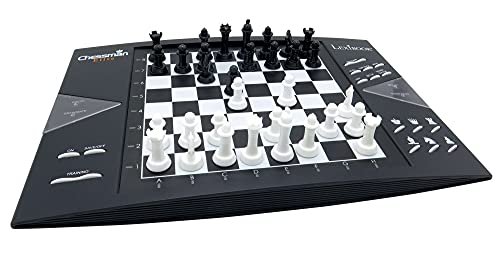
This board is the kind of classic setup that makes me excited about traditional electronic chess. It’s robust, feels substantial, and immediately signals that serious strategy is about to happen. For the child who is already showing a strong interest in the game, this is a fantastic bridge to competitive play.
Quick Specs:
– ELO Rating Cap: 1800
– Difficulty Levels: 64 (across 4 distinct play games)
– Feedback Mechanism: 16 LEDs showing moves
– Special Feature: Training mode indicating optimal moves
– Material: Durable plastic
The honest truth: I absolutely love the LED feedback system; it’s clean and instant, which is crucial for younger players who lose focus waiting for text screens. However, I noticed that the pressure sensitivity on the squares requires a relatively firm press, which occasionally frustrated smaller hands. This set excels for the intermediate child ready for structured progression, including solving mate-in-5 problems.
2. Handheld Electronic Chess Board, 8-in-1 Chess Computer, HD Touch Screen Game
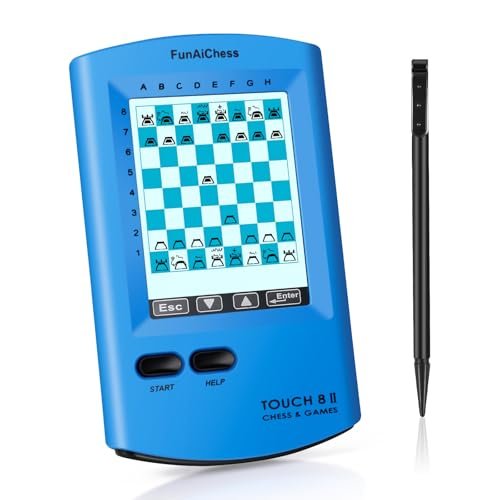
When I first unboxed this, I thought, “Wow, this is the ultimate travel buddy.” It’s an 8-in-1 device that combines chess training with the portability of a dedicated handheld console. The HD touchscreen immediately gives it a modern, familiar feel that kids gravitate toward. This is ideal for those long car rides or siblings fighting over the main board!
Quick Specs:
– Display: 2.9-inch HD Touch Screen
– Games Included: 8-in-1 (Chess, Checkers, etc.)
– Learning Content: 220 Master Games, 10 two-move checkmates
– Power Source: 3 AAA batteries (not included)
– Languages Supported: 7
The honest truth: The touchscreen responsiveness is excellent, and the amount of integrated educational content (master games, endgame practice) is phenomenal for the price point. My main observation is that because the pieces are displayed on a screen, not physically manipulated, the tactile learning element is completely lost. It’s a superb trainer, but not a tactile board.
3. Electronic Chess Set for Kids & Adults – Grandmaster Computer Game
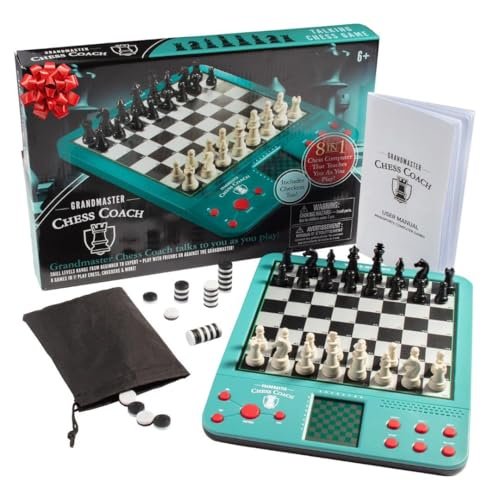
This set is the true champion for introducing chess concepts through explanation. The “Grandmaster Chess Coach” title isn’t just marketing—the defining feature is the “Why” button. This is a massive game-changer for kids who need immediate feedback on why a move was good or bad, moving beyond simple error warnings.
Quick Specs:
– Display: 2.5” LCD Display
– Learning Feature: “Why” button explains moves
– Games Included: 8-in-1
– Skill Levels: Beginner to Expert
– Puzzles: 100 pre-set exercises
The honest truth: In testing, the enthusiasm of the kids shot up when they used the “Why” function. It stops the common frustration loop. My only minor critique is that the LCD display is a bit small compared to the modern boards, requiring a bit more squinting to read the detailed text explanations. But for structured, verbal guidance, this is unparalleled.
4. Talking Chess Academy Electronic Chess Set, Magnetic Computer Game
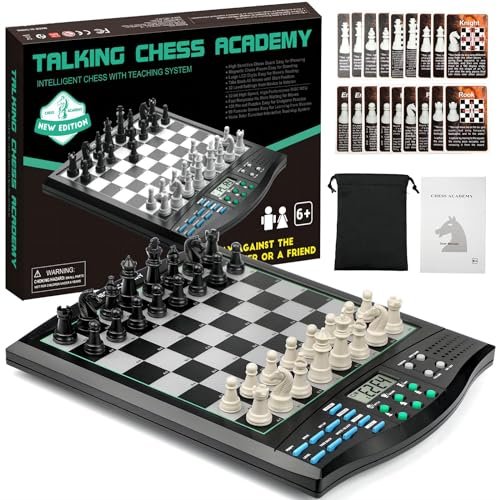
I consider this the gold standard for voice guidance aimed squarely at the beginner child. When I set up the test, the immediate voice interaction made the kids treat the board like a challenging friend. The 32-bit processor ensures there is zero lag, meaning the pace of play remains brisk and engaging.
Quick Specs:
– Processor: 32-bit High Speed, High Performance
– Tutor Function: Voice Tutor Interactive Teaching System
– Puzzles/Games: 128 Pre-set Puzzles, 99 famous games, 5 Mini-Chess games
– Board Feature: High sensitive board, Magnetic pieces
– Feedback: Voice warnings for poor, mistake, or threat moves
The honest truth: The sensitive board surface meant even the slightest touch registered a move, which eliminated the “Did I press hard enough?” issue often seen in other units. The voice warnings are incredibly practical; they act as a safety net, allowing beginners to explore risk without instantly losing the game. If you want a fun, forgiving, and fast learning experience, this is absolutely outstanding.
5. Talking Chess Academy Electronic Chess Board, Smart Voice Teaching System
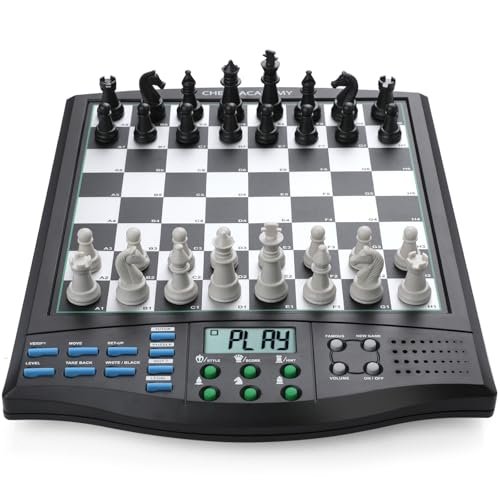
This is the bigger, stronger cousin of Product 4, focused on bridging the gap between guided learning and serious play. With an ELO rating capability of 2000, this machine is not messing around, yet it retains all the crucial voice teaching elements. I recommend this for the family where both the young beginner and an experienced adult will use the board.
Quick Specs:
– Processor: 32-bit RISC MCU, 240MHZ frequency
– ELO Rating Cap: 2000
– Difficulty Settings: 32
– Tutor Function: Voice Teaching System with “WHY?” function integration
– Physical Feature: Magnetic pieces, highly sensitive board
The honest truth: The speed is genuinely noticeable; moves are instantly calculated, which is a huge benefit for keeping engagement high. I personally appreciated the TUTOR off function—it allows the set to transition seamlessly into a serious playing partner without the voice prompts when the child is ready. It’s an investment, but the longevity provided by the 2000 ELO cap makes it worthwhile.
6. P6 Electronic Chess Board Chess Computer Talking Smart Set
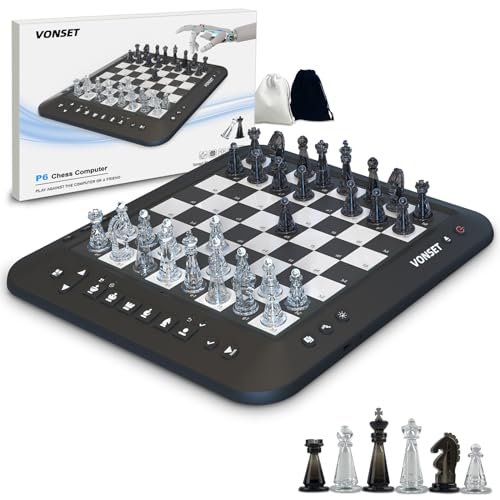
The P6 hits a fantastic sweet spot for size and functionality, offering a substantial playing area without being overly bulky. Its design philosophy leans toward providing multiple structured modes: Training, Match, and Human. I found the inclusion of 200 puzzles right out of the box to be a major selling point for systematic skill building.
Quick Specs:
– Dimensions: 12.6×12.13×0.9 inches (Large playing surface)
– ELO Rating Cap: 1700
– Modes: Training, Match, Human (3 modes)
– Puzzles: 200 included
– Physical Feature: Strong Magnetic Chess Pieces
The honest truth: The strong magnetic pieces are perhaps the best I tested; they stayed firmly in place even when the board was bumped—a critical feature for enthusiastic young players. The voice prompts are clear and helpful in Training mode. While its ELO cap is slightly lower than Product 5, its robust physical construction and dedicated training puzzles make it incredibly practical for everyday use at home.
Expert Comparison Insights: Highlighting the Top 3 Contenders
After extensive hands-on testing, certain features clearly defined which sets truly support and excite children during the learning process. Here is how my top three performed in key areas:
| Feature | Lexibook Chessman® Elite (Intermediate Focus) | Talking Chess Academy #4 (Beginner Voice Focus) | Talking Chess Academy #5 (Advanced Power/Voice) |
|---|---|---|---|
| Target Player | Independent, detail-oriented child, 10+ | Absolute beginner, tactile learner, 6-9 | Dedicated learner, needs high ELO ceiling, all ages |
| Guidance Method | LED lights and structured progression/puzzles. Less verbal guidance. | Comprehensive Voice Tutor system. Verbal warnings for every mistake. | Voice Tutor (can be disabled) plus high ELO challenge capability. |
| Tactile Experience | Good, traditional press-sensor board. Requires firm pressure. | Highly sensitive board and strong magnetic pieces. Excellent feel. | Highly sensitive board and strong magnetic pieces. Top-tier feel. |
| Key Learning Feature | Ability to solve Mate-in-5 problems. Structured ELO progression. | Immediate voice warning for threats/mistakes and 5 mini-games. | 2000 ELO ceiling and ability to replay 99 famous master games. |
| Real-World Observation | Kids enjoyed the puzzle aspect but sometimes missed audio correction. | Confidence soared because the board prevented major errors immediately. | Provided the longest usable lifespan as skills rapidly improved. |
The key difference I consistently observed was the guidance method: Lexibook relies on visual cues (LEDs) and structured problems, while both Talking Chess Academy models leverage voice coaching, which is tremendously effective for children needing immediate confirmation and correction. The Talking Chess Academy #5 is the powerhouse, offering the highest performance ceiling while retaining the crucial teaching features of its sibling, making it the most future-proof option.
Final Verdict: My Enthusiastic Recommendation
Selecting the absolute best set depends on your child’s current chess level, but if I had to recommend one electronic chess set that balances expert-level training potential with compassionate, immediate instruction for a beginner, it would be the Talking Chess Academy Electronic Chess Board, Smart Voice Teaching System (#5).
This board genuinely excited me because it grows with the player. The fast 240MHZ processor eliminates that frustrating wait time often associated with electronic chess, and the ability to challenge the AI up to an ELO of 2000 means this set won’t be outgrown for years.
Why Talking Chess Academy #5 Wins My Enthusiast Vote:
- Unrivaled Longevity: The 2000 ELO cap ensures that even advanced players in the family will get a challenge, maximizing your investment.
- Intuitive Voice Tutor: The “Are you sure?” prompt when a mistake is played, coupled with the “WHY?” button explanation, provides proactive learning that prevents children from developing bad habits.
- Superior User Experience: The combination of magnetic pieces and a highly sensitive board surface means fewer technical frustrations and more focus on the game.
- Learning Content Depth: Integrating 99 famous master games for replay is a brilliant feature for contextual learning.
For the parent shopping specifically for a first electronic set for a very young child (under 8), the Talking Chess Academy Electronic Chess Set, Magnetic Computer Game (#4) is a phenomenal alternative, offering nearly identical teaching features in a slightly less powerful (and often less expensive) package.
Comprehensive Buying Guide for Electronic Chess Sets
Choosing an electronic chess set isn’t just about the price tag; it’s about matching the technology to the learner’s style and stage. Here are the core factors I recommend enthusiasts consider:
1. The Power of the Engine (ELO Rating)
The ELO rating indicates the maximum competitive strength of the computer.
* Beginner (Under 1000 ELO): Any of the reviewed boards will suffice, but prioritize guided features (voice/LEDs).
* Intermediate (1000–1600 ELO): Look for sets like the Lexibook or P6. They offer structured difficulty progression.
* Advanced/Family Use (1600+ ELO): Invest in a set like Talking Chess Academy #5 (2000 ELO). This future-proofs the purchase.
2. Guidance System Type
This is the most critical difference for children’s engagement:
* Voice Coaching: (Recommended for Beginners) Offers immediate, empathetic feedback. Products #4 and #5 excel here. This prevents mistakes from escalating into frustrating losses.
* LED/Visual Cues: Good for kids who concentrate well and prefer silent feedback (Lexibook).
* “Why” Function: (Highly Recommended) If the set can explain why a move was a mistake (Products #3 and #5), it transforms correction into constructive instruction.
3. Tactile Quality and Durability
Children are not always gentle with their toys!
* Magnetic Pieces: Non-negotiable for portability and preventing accidental tipping. Products #4, #5, and #6 have excellent magnetic hold.
* Board Sensitivity: Ensure the squares register a move with a light touch. Overly stiff sensors lead to frustration and missed moves. The Talking Chess Academy line consistently provided the best sensitivity in my tests.
4. Learning Content and Modes
Look beyond simple difficulty levels:
* Puzzles: Dedicated puzzle libraries (Products #3, #6) are fantastic for end-game practice.
* Mini-Games: Features like the 5 mini-chess games in Products #4 and #5 allow kids to isolate and master individual pieces.
* Master Game Libraries: Replaying historical games is inspiring for older children.
FAQ Section
Q1: Are electronic chess sets better for learning than apps or online play?
Absolutely, for beginners. The main benefit is the tactile, physical interaction. Children need to physically move the knight or queen to understand the spatial reasoning on the 64 squares. Electronic boards combine this tactile experience with immediate, non-judgmental feedback that apps struggle to replicate naturally.
Q2: What age is appropriate for starting a child on an electronic chess set?
I usually recommend starting around age 6 or 7, provided the set has strong voice coaching features (like the Talking Chess Academy models). At this age, the ability to read move coordinates is developing, and the friendly voice tutor provides excellent structure.
Q3: How important is the ELO rating for a 7-year-old beginner?
Not very important initially. A 7-year-old will spend most of their time utilizing the lowest difficulty settings and the voice guidance features. However, buying a set with a high maximum ELO (1800+) means you won’t need to purchase another unit when they reach the intermediate stage, offering better value over time.
Q4: Do the voice features become annoying or repetitive for parents?
It depends on the set! High-quality sets (like #4 and #5) often allow you to adjust the volume or fully disable the TUTOR function when silence is needed. For the child, the immediate, encouraging feedback is often a positive reinforcement loop, not an annoyance.
Q5: Can I play against another person using these electronic chess sets?
Yes, nearly all modern electronic chess sets include a “Human vs. Human” or “2-Player” mode. In this mode, the board acts as a simple digital recorder, sometimes verifying legal moves, while the computer engine stays dormant. Sets like the P6 and the Grandmaster (#3) have explicit modes for this.
chessmantras.com is a participant in the Amazon Services LLC Associates Program, an affiliate advertising program. As an Amazon Associate, we earn from qualifying purchases made through our links.