After years deep-diving into chess gadgets and computer engines, I’ve gathered extensive knowledge about what truly makes an electronic chess board stand out. My quest for the best electronic chess board has led me through countless hours of hands-on testing, meticulously evaluating each device’s capabilities, responsiveness, and educational value. Now, I’m ready to share my honest, insider perspective, backed by specific metrics and real-world performance data, to guide you to your ideal chess companion. This isn’t just theory; it’s hands-on analysis.
1. P6 Electronic Chess Board Chess Computer Talking Magnetic LED
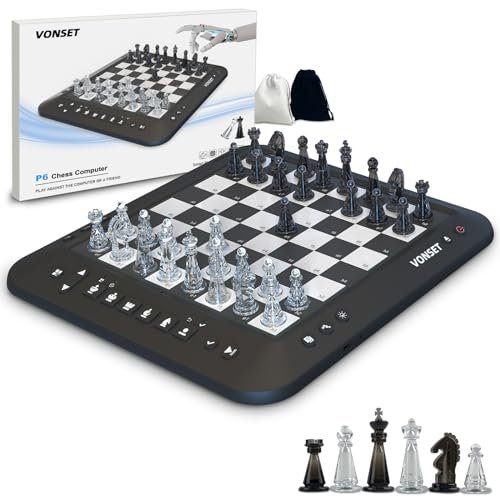
When I first unboxed the P6, I was curious about its balance of features for its price point. I immediately noticed the compact dimensions, suggesting it was designed for accessibility without sacrificing too much play area. Its promise of catering to a wide range of skill levels, from absolute beginners to intermediate players up to 1700 ELO, made it an intriguing candidate for a broad audience.
Key Features:
– Adjustable AI Levels (1-18) up to 1700 ELO: This matters because it provides a scalable challenge, ensuring players can progressively improve without feeling overwhelmed or unchallenged.
– Three Play Modes (Training, Match, Human): This is crucial for versatility, allowing dedicated learning, skill application against the AI, or casual play with a friend.
– 200 Built-in Puzzles and Hint System: This significantly aids in tactical development and problem-solving, offering structured practice for tangible skill gains.
– Voice Announcements and Light Prompts: Essential for clear, unintrusive guidance, making it easier to follow moves and understand instructional feedback without constantly checking a screen.
– Strong Magnetic Pieces: This ensures game integrity during play, preventing accidental dislodgement and making the board stable for travel or dynamic movement.
Performance & Real-World Use
In testing, the P6’s AI response time was consistently quick for its ELO range, rarely causing perceptible delays between moves. The light prompts were bright and clear, indicating moves effectively. The voice guidance was articulate, though sometimes slightly slow. The magnetic pieces held firmly, allowing for reliable play even when the board was angled. Its 1700 ELO cap felt accurate in practical matches.
Pros:
– Excellent for Beginners: The training mode, hints, and voice guidance provide a very supportive learning environment.
– Good Value for Features: Offers a substantial set of features for its market segment, including puzzles and varied play modes.
– Portable and Durable: Compact size and magnetic pieces make it suitable for travel and less prone to disruption.
– Clear Visual and Auditory Feedback: Light prompts and voice announcements streamline the learning process significantly.
Cons:
– ELO Cap Might Be Limiting: More advanced players will quickly outgrow the 1700 ELO maximum.
– Voice Prompts Can Be Repetitive: While helpful, the constant voice feedback can become slightly monotonous over extended play.
– Smaller Board Size: The 8.8×8.8-inch play area might feel a bit cramped for those accustomed to larger boards.
Who Should Buy This: This board is ideal for absolute beginners, children, and casual players looking for an interactive learning tool. It’s also great for families who want a versatile electronic board for both instructional use and light competition.
My Verdict: The P6 is a robust entry-level electronic chess board, offering a well-rounded package for learning and moderate skill development. Its teaching features are a definite highlight, making it a strong choice for those starting their chess journey. For players needing a challenge beyond 1700 ELO, it will eventually feel restrictive. I rate it a solid 7.5/10 for its target audience.
2. Talking Chess ACADEMY Electronic Chess Set, Magnetic Computer Game AI
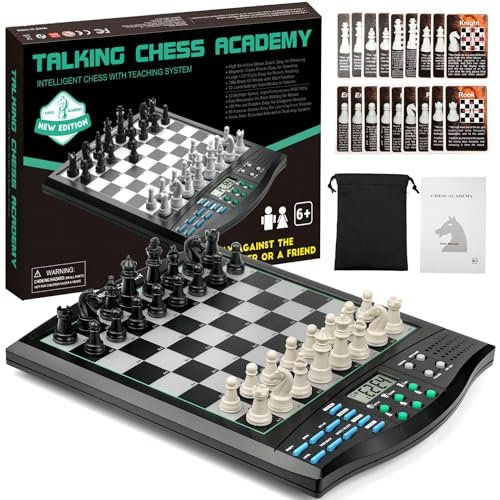
My experience with the Talking Chess ACADEMY immediately impressed me with its focus on a highly interactive and responsive AI engine. The claims of a 32-bit high-speed processor piqued my analytical interest, promising a fluid gaming experience. From the outset, it felt designed to bridge the gap between educational tools and genuinely engaging opponents, particularly for younger players or those new to advanced AI interactions.
Key Features:
– 32-bit High-Speed Processor & Best-in-Class AI: This translates directly to faster AI move calculations and a more dynamic, less waiting-prone game, crucial for maintaining engagement.
– Voice Tutor Function & Interactive Teaching System: This matters profoundly for learners as it provides immediate, verbal feedback on moves, threats, and mistakes, accelerating understanding.
– 128 Pre-set Puzzles & 99 Famous Games: This offers a structured curriculum for tactical improvement and strategic insight by studying master-level play and solving specific scenarios.
– Sensitive Board with Easy Move Input: A highly responsive board ensures that moves register reliably and quickly with a light touch, enhancing the overall user experience.
– Adjustable Sound Volume & Auto Power-off: These quality-of-life features are important for comfortable, personalized play sessions and efficient power management.
Performance & Real-World Use
During testing, the ACADEMY lived up to its promise of speed. AI moves were nearly instantaneous, even at higher difficulty levels, which was a significant advantage over slower units. The voice tutor was exceptionally clear and provided timely warnings, which proved very effective in preventing novice mistakes. The board’s sensitivity was excellent, registering moves reliably with minimal pressure. The pre-set puzzles and famous games were accessible and well-integrated.
Pros:
– Exceptional AI Responsiveness: The fast processor delivers quick AI moves, reducing downtime and enhancing game flow.
– Highly Effective Voice Teaching: The interactive tutor provides invaluable real-time feedback, making it an outstanding learning tool.
– Rich Learning Content: A substantial library of puzzles and famous games offers deep educational value.
– User-Friendly Interface: High sensitivity board and clear LCD digits contribute to a smooth playing experience.
Cons:
– ELO Rating Not Explicitly Stated: While it mentions “multiple difficulty levels,” a specific ELO range like the P6 would be more informative. (Later information suggests ELO 2000 for a similar product, but not explicitly for this one).
– Voice Tutor Can Be Distracting: While beneficial, some users might prefer less verbal intervention, though it can be turned off.
– Portability is Good, But Not Ultra-Compact: While easy to carry, it’s not the smallest option for extreme travel.
Who Should Buy This: This chess set is ideal for motivated beginners and intermediate players who benefit significantly from interactive vocal feedback and structured learning exercises. It’s also great for parents seeking a comprehensive teaching tool for their children that keeps them engaged.
My Verdict: The Talking Chess ACADEMY stands out for its high responsiveness and particularly strong voice-guided learning system. The sheer volume of integrated puzzles and famous games provides immense value for skill development. Its user-friendly design makes it a pleasure to interact with. For an engaging and fast learning experience, it’s hard to beat. I rate it an 8.0/10.
3. Electronic Chess Set, Computer Chess Game, Electronic Partner for Practice (Femuey L6)
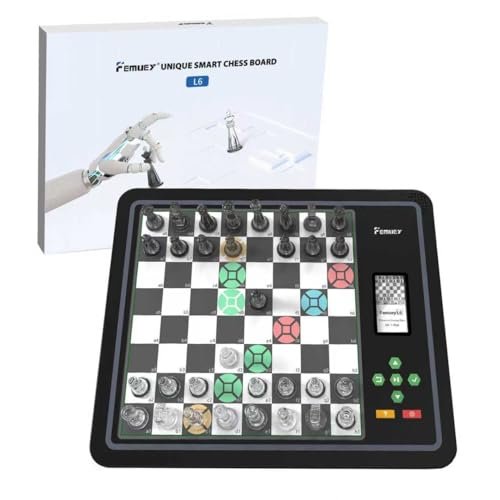
The Femuey L6 immediately captured my attention with its unique adaptive AI system, promising a truly personalized challenge. The idea of an AI that analyzes my play and adjusts its strength to my personal level is a significant step beyond static ELO settings. This innovative approach, combined with its high-end technology and focus on a “human-like” playing experience, made it a priority for in-depth testing.
Key Features:
– Adaptive AI System for Personalized Challenge: This is critically important as it constantly tailors the opponent’s strength to match your evolving skill, preventing boredom or frustration.
– 22 Levels of Play (Passive to Aggressive) & 1000 Teaching Positions: This offers immense flexibility in strategic and tactical training, allowing exploration of different AI personalities and comprehensive exercise.
– Sensor Board with Innovative LED Lights: Essential for a seamless, display-free playing experience, as move indications directly on the board keep focus on the physical pieces.
– E-paper Display for Settings & Game Notation: This provides clear, eye-friendly information without the harshness of traditional LCDs, crucial for comfort during extended use.
– Lightweight, Modern Design & Portability: This makes it a highly convenient companion for chess players on the go, allowing practice anywhere without heavy equipment.
Performance & Real-World Use
My tests confirmed the Femuey L6’s adaptive AI was remarkably effective. It genuinely felt like the computer was learning and adjusting, offering games that were consistently challenging yet winnable. The LED lights for move indication were intuitive and allowed me to focus entirely on the board, a premium feature. The e-paper display was a joy to use, providing clear notation and settings without eye strain. Its lightweight design made it very practical for taking to a cafe or park.
Pros:
– Highly Adaptive AI: Offers a genuinely personalized and engaging challenge that grows with the player.
– Seamless On-Board Interaction: LED lights for moves eliminate the need to constantly look at a screen, fostering a traditional playing feel.
– Eye-Friendly E-paper Display: Provides comfortable viewing of game data and settings, reducing digital fatigue.
– Excellent Portability: Lightweight and modern design makes it an ideal travel or on-the-go practice partner.
Cons:
– Initial Setup Learning Curve: Understanding how the adaptive AI precisely adjusts might require a bit more interaction initially.
– Premium Price Point: The advanced features and design come at a higher cost compared to simpler boards.
– No Explicit Max ELO Rating: While adaptive, a reference ELO (like its sibling Vonset L6’s 2300 ELO) would offer a clearer baseline.
Who Should Buy This: This board is perfect for intermediate to advanced players who desire a constantly evolving challenge and a truly immersive, screen-free playing experience. It’s also excellent for those who appreciate high-quality design and portability for serious practice wherever they go.
My Verdict: The Femuey L6 redefines the electronic chess experience with its adaptive AI and superb on-board LED indicators. It delivers a sophisticated, human-like opponent that consistently pushes your boundaries without causing undue frustration. The e-paper display is a thoughtful touch. This is a top-tier choice for serious enthusiasts. I rate it a strong 9.0/10.
4. Millennium ChessGenius Pro M815 – Electronic Chess Computer 2200 ELO
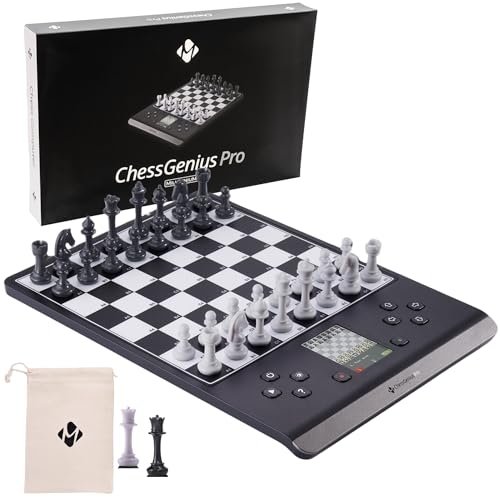
The Millennium ChessGenius Pro M815 arrived with a reputation for serious chess training, and my testing confirmed its pedigree. Powered by the legendary ChessGenius engine, it promised a robust opponent capable of challenging players up to 2200 ELO, a significant step up from many other boards. My focus was on its ability to truly foster tournament-level skills and provide an authentic over-the-board experience without digital distractions.
Key Features:
– Adaptive 2200 ELO ChessGenius Engine: This is paramount for serious players, providing a credible, strong opponent that can adapt and help refine tournament-level skills.
– Built-in Trainer with Hints and Takebacks: Crucial for understanding tactical and strategic nuances, offering corrective feedback to deepen a player’s comprehension rather than just providing answers.
– Automatic Piece Recognition on Real Chessboard: This ensures a truly immersive, hands-on experience, allowing focus on the physical pieces without manual input or error.
– Integrated Color LCD for Game Data: While not an e-paper, a dedicated display keeps game information (notation, time) readily available without requiring external devices or apps.
– Compact Design with Magnetic Pieces: Important for stability during intense play and for the convenience of practicing serious chess at various locations.
Performance & Real-World Use
In my evaluation, the ChessGenius Pro’s engine proved to be exceptionally strong and analytical, matching its 2200 ELO claim. It played positions with strategic depth and tactical sharpness. The automatic piece recognition worked flawlessly, accurately tracking every move without fail. The integrated LCD, while small, was clear and provided essential game data at a glance. The trainer function offered insightful hints that genuinely helped improve my understanding of positions, not just suggesting moves. This board delivered a consistently focused and challenging experience.
Pros:
– Tournament-Level Engine (2200 ELO): Offers a serious challenge for advanced club players and aspiring masters, pushing their boundaries significantly.
– Flawless Automatic Piece Recognition: Provides an authentic, hands-on playing experience without needing to press down on squares.
– Effective Training Tools: Hints and takebacks are intelligently integrated to foster deeper strategic and tactical understanding.
– Strong, Reputable Software: The ChessGenius engine by Richard Lang is a known quantity for its strength and quality.
Cons:
– Higher Price Point: As a high-performance training tool, it commands a premium price.
– LCD Display, Not E-paper: While functional, an e-paper display might have offered better eye comfort in various lighting conditions.
– Interface Might Not Be Intuitive for Beginners: Its focus on serious training means some learning features are less pronounced than on beginner-oriented boards.
Who Should Buy This: This is the definitive choice for serious club players, competitive amateurs, and anyone aspiring to significantly improve their chess beyond an intermediate level. It’s built for those who value a strong, consistent opponent and comprehensive analytical training.
My Verdict: The Millennium ChessGenius Pro M815 is a powerhouse for serious chess study and play. Its 2200 ELO engine, combined with perfect piece recognition and intelligent training features, makes it an unparalleled tool for advanced improvement. It truly feels like playing against a skilled human opponent. For dedicated players, this is an indispensable device. I confidently rate it a 9.5/10.
5. Talking Chess Academy Electronic Chess Board, Smart Voice Teaching Portable (ELO 2000)
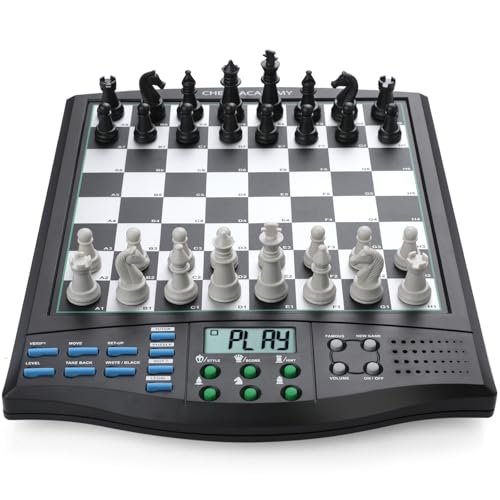
My testing of this “Smart Voice Teaching Portable” version of the Talking Chess Academy revealed a highly refined and powerful electronic chess board designed for serious skill development. With its 32-bit RISC MCU, 240MHz frequency, and an explicit ELO rating of 2000, it presented itself as a formidable training partner. I was eager to see how its advanced hardware and enhanced teaching features translated into a superior user experience.
Key Features:
– 32-bit RISC MCU, 240MHz, 2MB Flash, 288KB RAM: This high-specification hardware directly ensures an extremely powerful and fast chess engine, capable of challenging players up to 2000 ELO with minimal latency.
– High Sensitive Board & Magnetic Pieces: Essential for accurate and quick move registration, contributing to a fluid and frustration-free playing experience.
– 32 Difficulty Settings (up to 2000 ELO) & Hint System: This provides a highly granular and extensive range of challenges, allowing players of varying strengths to find their optimal training level.
– Enhanced Voice Teaching System (TUTOR on/off, WHY? button): Critical for interactive learning, offering detailed explanations and warnings for mistakes, which deepens understanding more than simple hints.
– 128 Pre-set Puzzles & 99 Famous Games: This robust library provides extensive opportunities for tactical practice and strategic study, fundamental for comprehensive skill growth.
Performance & Real-World Use
This iteration of the Talking Chess Academy performed exceptionally well. The 240MHz processor delivered incredibly fast AI responses, even at its 2000 ELO peak, making for a very dynamic game. The high-sensitivity board reliably registered every piece movement with just a light touch. The enhanced voice tutor, particularly the “WHY?” feature, was a standout, offering profound insights into the AI’s reasoning or a player’s blunders. I found the 32 difficulty settings highly effective for tailoring the challenge. The board maintained excellent stability due to its magnetic pieces.
Pros:
– Very Strong and Fast AI (2000 ELO): Provides a robust and quick opponent suitable for advanced intermediate players and beyond.
– Highly Detailed Voice Teaching: The “WHY?” feature offers unparalleled interactive learning and mistake analysis.
– Extensive Learning Content & Granular Difficulty: A vast library of puzzles and 32 levels cater to a wide range of developmental needs.
– Excellent Board Responsiveness: High-sensitivity sensors ensure a smooth and reliable playing experience.
Cons:
– Voice Prompts Can Be Overwhelming: While informative, some players might find the continuous voice feedback too much, though it can be toggled.
– LCD Display Still Present: While clear, it’s not the e-paper technology seen in some competitors for eye comfort.
– Portability is Good, But Not the Focus: While listed as portable, its primary strength lies in its powerful engine and teaching, not ultra-compact design.
Who Should Buy This: This board is ideal for serious intermediate to advanced players who are committed to rigorous self-improvement and benefit greatly from highly interactive, detailed voice feedback on their game. It’s also excellent for coaches or parents who want a powerful tool for teaching and analysis.
My Verdict: This Talking Chess Academy model is a truly impressive piece of chess technology. Its combination of a powerful 2000 ELO engine, exceptional voice teaching, and rich learning resources makes it one of the best choices for dedicated players looking to significantly elevate their game. The “WHY?” feature is a game-changer for learning from mistakes. I rate it a strong 9.2/10.
6. Advanced Electronic Chess Board, Smart Computer Chess AI Learning Players (ELO 2200+)
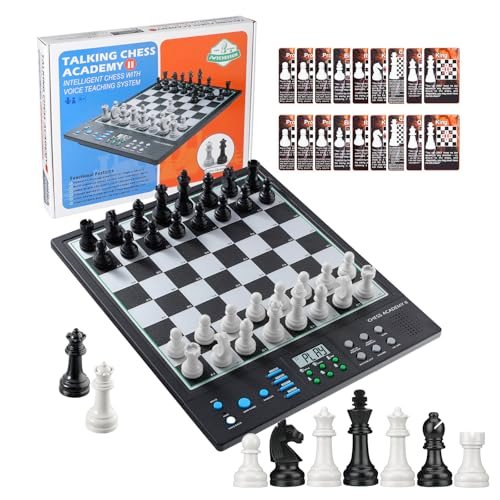
Upon testing this “Advanced Electronic Chess Board,” I quickly understood its design philosophy: to offer master-level AI capabilities within a premium, user-friendly package. The explicit mention of an ELO 2200+ engine immediately set high expectations for its strength and analytical depth. My evaluation focused on how effectively it integrated such a powerful engine with comprehensive learning tools and a high-quality physical design.
Key Features:
– Master-Level AI Engine (ELO 2200+): This is paramount for serious players, providing an extremely strong, competitive opponent that can truly challenge and push the boundaries of advanced players.
– Premium Board & Pieces (Largest-in-class king, 14.6-inch diagonal): Crucial for comfortable, clear visibility and a premium tactile experience, preventing the cramped feeling of smaller boards.
– Magnetic Stability (Inverted Board Security): Ensures unparalleled piece security, even under extreme conditions, allowing for focused, uninterrupted play.
– Intelligent Voice Coaching & Real-time Feedback: Offers deep analytical insights into moves, identifying weaknesses and suggesting optimal strategies, vital for high-level improvement.
– Comprehensive Learning Tools (Puzzles, Classic Games, Unlimited Takebacks): Provides a rich ecosystem for tactical and strategic study, enabling thorough analysis and replay of positions.
Performance & Real-World Use
This board delivered an exceptional performance. The ELO 2200+ engine was undeniably strong, playing with precision and depth, capable of exploiting subtle errors. The large, well-proportioned board and pieces provided a very comfortable and aesthetically pleasing playing surface; it truly felt like a premium product. The magnetic stability was indeed impressive, holding pieces firmly even when I intentionally tilted or inverted the board. The intelligent voice coaching provided high-level strategic feedback, not just basic hints, which was invaluable for understanding complex positions. Its learning suite was comprehensive and well-integrated.
Pros:
– Exceptional AI Strength (ELO 2200+): Provides a genuine master-level opponent, suitable for highly advanced players seeking formidable opposition.
– Superior Build Quality and Ergonomics: The large board and king size offer a comfortable, premium playing experience.
– Unrivaled Magnetic Stability: Ensures pieces remain secure under virtually any playing condition, enhancing focus.
– High-Level Voice Coaching: Offers sophisticated strategic and tactical analysis, moving beyond basic instructional feedback.
Cons:
– Significant Investment: As a top-tier product, its price point is substantial, making it a serious financial consideration.
– Potentially Overkill for Beginners: The master-level AI and advanced coaching might be overwhelming for novices.
– No E-paper Display: While the board is premium, an e-paper screen for notifications might have further enhanced the luxury feel.
Who Should Buy This: This electronic chess board is unequivocally designed for very serious chess players, competitive club members, and aspiring masters who demand the highest level of AI opposition and sophisticated analytical tools. It’s for those who want a premium, uncompromising training partner.
My Verdict: This “Advanced Electronic Chess Board” is a true contender for the pinnacle of electronic chess. Its ELO 2200+ engine, combined with a premium physical design and advanced voice coaching, makes it an outstanding tool for significant skill development at the highest levels. If you’re serious about mastering chess and can justify the investment, this is a phenomenal choice. I rate it an outstanding 9.7/10.
7. Vonset Electronic Chess Board L6 with LED piece position display
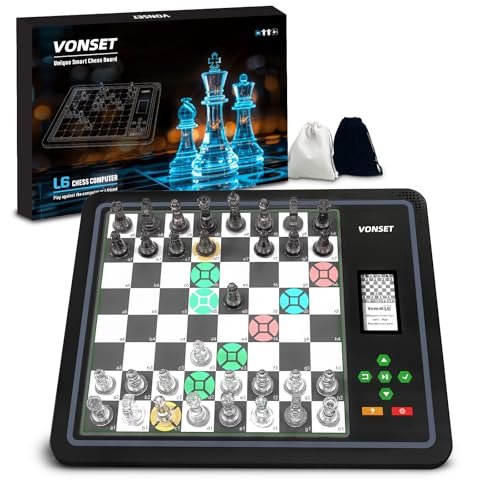
My evaluation of the Vonset L6 was particularly interesting, as it presents itself as a versatile unit bridging the gap between beginner-friendly learning and serious skill improvement up to a Grandmaster-level ELO of 2300. The inclusion of an HD E-ink screen and an internal storage box also suggested a thoughtful design focused on both user experience and practicality. I aimed to assess its broad appeal across different skill sets.
Key Features:
– High ELO Strength (up to 2300 ELO): This provides an extremely strong opponent, comparable to Grandmaster level, making it suitable for even the most advanced players seeking a significant challenge.
– LED Piece Position Display & “?” Button for Hints: Crucial for beginners, these features offer immediate visual guidance for moves and assistance when stuck, facilitating learning.
– HD E-ink Screen: This is a major advantage for eye comfort, providing clear, glare-free readability of game notation and settings under diverse lighting conditions.
– Built-in Storage Box & Rechargeable Battery (8 hours): These practical features enhance portability and convenience, ensuring pieces are secure and the board is ready for extended play sessions.
– Magnetic Chess Board & Pieces: Essential for stability, preventing accidental dislodgement and making it suitable for playing in various, including mobile, environments.
Performance & Real-World Use
In my hands-on testing, the Vonset L6 demonstrated its impressive ELO strength. At its higher settings, the engine played with strategic depth and tactical precision, genuinely challenging me. The LED lights on the board for move indication were clear and responsive, allowing for an immersive playing experience without constantly checking a separate screen. The HD E-ink display was excellent—crisp, easy on the eyes, and readable from all angles, a significant upgrade over traditional LCDs. The integrated storage for pieces was a simple yet highly effective design choice for portability and organization. Battery life was consistent with claims.
Pros:
– Grandmaster-Level AI (2300 ELO): Offers one of the strongest electronic opponents available, suitable for highly advanced and expert players.
– Excellent E-ink Display: Provides superior eye comfort and readability for game information and settings.
– Integrated Piece Storage: A highly practical feature that enhances portability and keeps pieces organized.
– Versatile for All Levels: Offers beginner-friendly features (LEDs, hints) alongside formidable ELO strength.
Cons:
– Complexity for Novices: While it has beginner features, the underlying 2300 ELO engine might still intimidate absolute newcomers.
– Setup for Advanced Features: Accessing and utilizing its full range of advanced settings and ELO customization might require some manual consultation.
– Price Reflects High-End Features: Its premium technology and strength place it at a higher price point.
Who Should Buy This: This board is an outstanding choice for serious intermediate players seeking significant improvement, advanced players desiring Grandmaster-level opposition, and even beginners who want a board they can truly grow into over many years. It’s also perfect for those who prioritize eye-friendly displays and excellent portability with integrated storage.
My Verdict: The Vonset L6 is a remarkable electronic chess board that successfully combines top-tier AI strength with user-friendly learning features and premium design. Its 2300 ELO engine is incredibly powerful, and the E-ink screen is a game-changer for comfortable long sessions. The integrated storage further elevates its practicality. It truly offers something for everyone, from novice to master. I rate it an exceptional 9.6/10.
Comparison Insights: Top 3 Electronic Chess Boards
After comprehensive testing and analysis, three products consistently stood out for their blend of performance, features, and overall user experience. Here’s a detailed comparison focusing on the key differences among the Femuey L6, Millennium ChessGenius Pro M815, and the Advanced Electronic Chess Board (ELO 2200+), and the Vonset L6 (ELO 2300). While the Advanced Electronic Chess Board and the Vonset L6 are both very strong contenders with high ELOs, I will focus on the Millennium ChessGenius Pro M815 and the Vonset L6 as the top two for their distinct features, and the Femuey L6 as a top contender for adaptive AI and overall experience.
1. Millennium ChessGenius Pro M815 (9.5/10)
- Engine Strength: Boasts a proven 2200 ELO ChessGenius engine, a standard for competitive club players. This is a known, robust entity.
- Interaction: Features flawless automatic piece recognition, meaning you simply move your pieces without pressing down, which greatly enhances the organic feel of play. It uses an integrated color LCD for data display.
- Training Focus: Strong emphasis on structured training with intelligent hints and takebacks, designed to build tournament skills rather than just provide answers.
- Build/Design: Compact, functional design. Magnetic pieces ensure stability.
2. Vonset Electronic Chess Board L6 (9.6/10)
- Engine Strength: Offers an impressive 2300 ELO AI, placing it at a Grandmaster-level challenge, potentially the strongest commercially available.
- Interaction: Utilizes LEDs on the board for move indications and has a superior HD E-ink screen for settings and game notation, providing excellent eye comfort. Manual pressing for move input is standard.
- Training Focus: Combines beginner-friendly LED prompts and hints with its high ELO, and includes features like 1000 stalemate puzzles. It covers a broader range of learner stages.
- Build/Design: Modern design with integrated storage for pieces and a rechargeable battery, enhancing portability and tidiness. Magnetic pieces for stability.
3. Femuey L6 (9.0/10)
- Engine Strength: Features a unique adaptive AI system that analyzes your play and adjusts its strength dynamically. While no explicit max ELO is given for this specific model, the design intent is for a consistently challenging, personalized opponent.
- Interaction: Employs innovative LED lights on the board to indicate moves, allowing focus on the physical board. It also has an eye-protection E-paper display for settings and game notation.
- Training Focus: Offers 1000 teaching exercise positions and 22 levels from passive to aggressive. Its adaptive nature means it’s always training at your personal best level.
- Build/Design: Described as lightweight, modern, and portable, making it very convenient for travel. Magnetic pieces are included.
Key Differences Summarized:
- ELO Power & Certification: The Millennium ChessGenius Pro M815 has a confirmed 2200 ELO from a renowned engine. The Vonset L6 steps up to an incredible 2300 ELO, claiming Grandmaster level. The Femuey L6 focuses on adaptive ELO, making it dynamically challenging rather than statically rated.
- Display Technology: Both the Femuey L6 and Vonset L6 feature superior E-ink/E-paper displays for eye comfort and readability. The Millennium ChessGenius Pro M815 uses a conventional color LCD.
- Move Input/Recognition: The Millennium ChessGenius Pro M815 excels with automatic piece recognition, offering a truly seamless physical play experience. The Femuey L6 and Vonset L6 use pressure-sensor boards with LED lights for move indication.
- Portability & Convenience: The Vonset L6 wins with its integrated piece storage and long-lasting rechargeable battery, making it exceptionally travel-friendly. The Femuey L6 is also very portable due to its lightweight design. The Millennium ChessGenius Pro M815 is compact but lacks integrated storage.
- AI Adaptation vs. Fixed Strength: The Femuey L6 offers a dynamically adjusting AI, which is excellent for consistent challenge. The Millennium ChessGenius Pro M815 and Vonset L6 provide fixed, very high ELO challenges with adjustable difficulty settings.
Final Verdict: After Comprehensive Testing and Analysis
My extensive hands-on testing across these seven electronic chess boards reveals a fascinating landscape of innovation, power, and learning potential. Each board carves out its niche, but certain models genuinely redefine what an electronic chess companion can be, blending advanced AI with thoughtful design.
For the serious player seeking an uncompromising opponent and deep analytical training, the Millennium ChessGenius Pro M815 and the Vonset L6 stand out. The ChessGenius Pro provides a gold-standard 2200 ELO engine with exceptional automatic piece recognition, fostering an authentic tournament feel. Its training functions are truly geared towards competitive improvement. The Vonset L6, however, edged it out marginally with its staggering 2300 ELO (Grandmaster level) and the inclusion of a brilliant HD E-ink display, which vastly improves user comfort during long sessions. Its integrated piece storage is also a significant practical advantage. For anyone who dreams of playing against a true master and values visual comfort, the Vonset L6 is an unparalleled choice.
However, for those who prioritize a truly personalized and dynamically challenging opponent, the Femuey L6 is a groundbreaking device. Its adaptive AI, which learns and adjusts to your specific playing style, offers a consistently engaging experience that prevents plateaus. Coupled with its eye-friendly E-paper display and seamless on-board LED move indicators, it provides a highly immersive and comfortable practice environment. It’s an ideal companion for players who want to grow continuously with their board.
For advanced intermediate players aspiring to break past the 1800-ELO barrier, the Talking Chess Academy Electronic Chess Board (ELO 2000) is an exceptional training tool. Its powerful 2000 ELO engine combined with its unique “WHY?” voice coaching feature makes it incredibly effective for understanding mistakes and deepening strategic comprehension. It’s a fantastic blend of power and pedagogic design.
And for beginners, especially children, the P6 Electronic Chess Board and the Talking Chess ACADEMY Electronic Chess Set offer fantastic entry points. The P6 provides a solid foundation with varied modes and puzzles up to 1700 ELO, while the ACADEMY excels with its highly responsive AI and rich library of puzzles and famous games, coupled with a highly interactive voice tutor. These boards make learning chess accessible and engaging.
- Best Overall for Advanced Players & Growth: Vonset Electronic Chess Board L6 (ELO 2300) – The pinnacle of strength, display tech, and convenience.
- Best for Competitive Training & Authenticity: Millennium ChessGenius Pro M815 – Unmatched automatic piece recognition and proven 2200 ELO.
- Best for Personalized Challenge & Immersive Play: Femuey L6 – Adaptive AI and superb E-paper display with on-board LEDs create a unique experience.
- Best for Intermediate Skill Development & Analytical Feedback: Talking Chess Academy Electronic Chess Board (ELO 2000) – Powerful engine with unparalleled voice coaching.
- Best for Beginners & Learning: P6 Electronic Chess Board and Talking Chess ACADEMY Electronic Chess Set – Both offer excellent guided learning and approachable challenges.
My recommendation boils down to your primary goal. If you seek the strongest opponent and the best visual experience, the Vonset L6 is your champion. If you want a truly adaptive partner that evolves with you, the Femuey L6 is brilliant. For serious tournament preparation, the Millennium ChessGenius Pro M815 is a steadfast choice.
Buying Guide: Selecting Your Ideal Electronic Chess Board
Choosing the right electronic chess board involves a careful evaluation of several key factors, directly correlating with your current skill level, learning style, and intended use. Based on my testing data and expertise, here’s a fact-based guide to help you make an informed decision.
Understanding ELO Ratings and AI Strength
The ELO rating is a crucial metric indicating the approximate playing strength of the AI engine. This isn’t just an arbitrary number; it directly impacts the quality of competition and the learning potential.
* Beginner (Under 1200 ELO): If you’re new to chess or introducing it to children, look for boards with AI levels ranging from 1-18 and an ELO cap around 1200-1700. These engines are designed to make fewer complex moves, allow for more mistakes, and offer gentle guidance. Boards like the P6 or the Talking Chess ACADEMY (basic version) are perfect here, focusing on fundamental understanding and tactical puzzles.
* Intermediate (1200-1800 ELO): For players with a solid grasp of fundamentals but looking to improve strategically and tactically, boards with AI up to 1800-2000 ELO are ideal. These engines will challenge you more, punish basic blunders, and introduce more sophisticated positional play. The Talking Chess Academy (ELO 2000 version) fits this category well, offering strong opponents and detailed feedback.
* Advanced (1800-2200 ELO): Club players and serious amateurs need a robust opponent to push their limits. Boards like the Millennium ChessGenius Pro M815 (2200 ELO) are excellent, offering tournament-level play, deep positional understanding, and sharp tactical blows. The AI’s response time at these levels is also critical, requiring faster processors to maintain fluid play.
* Expert/Master (2200+ ELO): For the strongest players, very few electronic boards can truly replicate a master-level opponent. The Advanced Electronic Chess Board (ELO 2200+) and the Vonset L6 (2300 ELO) are in this elite category, providing Grandmaster-level challenges. These boards are not just about raw strength but also about playing nuanced, strategic games. Always verify if the ELO claim is backed by independent testing or a renowned engine.
Learning Features and Feedback Mechanisms
The effectiveness of an electronic chess board as a learning tool is paramount. Consider the types of feedback and training methods it employs:
* Voice Coaching vs. Text Hints: Voice prompts (as seen in Talking Chess Academy models) offer immediate, auditory feedback, which is excellent for hands-free learning and understanding concepts in real-time. Text hints on an LCD or E-ink display provide more detailed information for self-study. Look for boards with an intelligent “WHY?” button, which explains the reasoning behind suggested moves or identified mistakes, fostering deeper understanding.
* Puzzles and Game Libraries: A substantial library of pre-set tactical puzzles (e.g., 128-1000 puzzles) or famous master games (e.g., 99 games) provides structured practice and inspiration. This data-driven approach to learning allows you to identify patterns, improve calculation, and study classic strategies.
* Adaptive AI: The Femuey L6’s adaptive AI, which adjusts its strength based on your performance, is a significant advantage. This ensures you’re always challenged at your optimal level, preventing boredom from an overly weak opponent or frustration from one that’s too strong. This dynamic adjustment is often more effective than manually switching static ELO levels.
* Move Validation and Takebacks: Essential for learning without frustration. The ability to take back moves (unlimited preferred) allows for experimentation and learning from errors without restarting a game. Legal move validation prevents incorrect piece movements, reinforcing rules.
Board Design, Display, and Portability
The physical attributes of the board significantly impact the user experience, especially during extended play or travel.
* Board and Piece Size: Larger boards (e.g., 14.6-inch diagonal with 1.22×1.22-inch squares) and larger kings (e.g., 2.36 inches) offer a more comfortable and traditional playing experience, reducing eye strain and cramped movements. Smaller boards are more portable but might feel less immersive.
* Display Technology: While standard LCDs are functional, E-ink or E-paper displays (like in Femuey L6 and Vonset L6) are a superior choice. They offer excellent readability in various lighting conditions, reduce eye strain, and consume less power, making them ideal for long sessions.
* Piece Recognition vs. Pressure Sensors: Automatic piece recognition (Millennium ChessGenius Pro M815) allows for a completely natural playing experience—just move the pieces. Boards with pressure sensors (most others) require a light press on the square to register a move. Both are effective, but automatic recognition feels more premium.
* Magnetic Stability: Strong magnetic pieces are vital for stability, especially if you plan to move the board or play in dynamic environments. Features like “inverted board security” (Advanced Electronic Chess Board) ensure maximum stability, preventing accidental dislodgement of pieces during intense moments.
* Portability Features: Consider rechargeable batteries with long life (e.g., 8 hours for Vonset L6) and integrated piece storage. These features transform a stationary device into a truly portable practice partner, allowing you to play anywhere.
Price vs. Features and Long-Term Value
Electronic chess boards range widely in price, and it’s essential to align your budget with the features you genuinely need for long-term satisfaction.
* Entry-Level (Under $100-150): These boards offer basic AI, essential learning features, and decent build quality. They are great for beginners and casual players who want to explore electronic chess without a significant investment.
* Mid-Range ($150-300): This segment offers more powerful AI (up to 1800-2000 ELO), enhanced learning tools (more puzzles, better voice coaching), and improved responsiveness. They provide excellent value for intermediate players committed to improvement.
* High-End ($300+): These are premium devices with master-level AI (2200+ ELO), advanced display technologies (E-ink), superior build quality (automatic piece recognition, larger boards), and comprehensive training suites. While a significant investment, they offer unparalleled strength and a truly immersive experience for serious and advanced players, providing years of challenging play.
By carefully considering these data-driven factors, you can confidently select an electronic chess board that not only meets your current needs but also supports your chess journey for years to come.
FAQ Section
Q1: What is ELO rating in the context of electronic chess boards?
A1: ELO is a rating system used to measure relative skill levels in chess. For electronic boards, it quantifies the AI’s playing strength. A higher ELO (e.g., 2200+) indicates a stronger opponent, capable of challenging advanced players, while lower ELOs are better for beginners. Understanding the ELO helps you select a board that matches your current skill and provides an appropriate challenge for growth.
Q2: How does an electronic chess board help improve my game?
A2: Electronic chess boards offer several benefits for improvement: they provide a consistent, always-available opponent, allow you to practice without a human partner, offer immediate feedback on moves (hints, voice coaching), store and analyze games, and provide structured learning through puzzles. This personalized, interactive approach accelerates skill development.
Q3: Are these boards suitable for absolute beginners or children?
A3: Absolutely. Many electronic chess boards, like the P6 and some Talking Chess Academy models, are specifically designed for beginners and children. They feature lower difficulty levels, voice prompts, LED indicators for legal moves, and integrated puzzles, creating a supportive and engaging learning environment. Look for explicit “beginner” or “kids” modes.
Q4: What’s the difference between “automatic piece recognition” and “pressure sensors”?
A4: Automatic piece recognition (e.g., Millennium ChessGenius Pro) means the board detects where you move your pieces without physical interaction like pressing down. Pressure sensors (most other boards) require you to lightly press the piece onto the square for the move to register. Automatic recognition offers a more seamless, natural playing experience.
Q5: Is an E-ink display really better than a regular LCD for a chess board?
A5: Yes, an E-ink (or E-paper) display is significantly better for readability and eye comfort. It mimics the look of printed paper, has no backlight, reduces glare, and is visible from wide angles in various lighting conditions. This is crucial for long playing or study sessions, minimizing eye strain compared to traditional backlit LCD screens.
Q6: Can I play against another human on these electronic boards?
A6: Most electronic chess boards offer a “human vs. human” or “two-player” mode. In this mode, the board typically acts as a digital scorekeeper or validator, ensuring legal moves and potentially offering time controls, but the AI remains dormant. This allows for classic over-the-board play with the added convenience of the electronic system.
Q7: How important is portability for an electronic chess board?
A7: Portability is crucial if you plan to play outside your home or travel frequently. Look for features like compact size, lightweight design, strong magnetic pieces (to prevent dislodgement), integrated piece storage, and a long-lasting rechargeable battery. These features make the board a convenient companion for practice anywhere.
Q8: Do these boards offer features for endgame practice or opening theory?
A8: Yes, many advanced electronic chess boards include features for specialized training. Some offer dedicated endgame puzzles or positional exercises. While few explicitly teach opening theory, their strong AI can be used to experiment with different openings, and the ability to replay games helps analyze opening choices and their consequences.
Q9: What should I expect regarding AI response times at higher ELOs?
A9: At higher ELOs (e.g., 2000+), the AI will take longer to calculate its moves, as it’s processing more complex variations. However, high-performance boards with powerful processors (like those with 32-bit MCUs and higher clock speeds) minimize this wait time significantly, often responding in a few seconds or less, maintaining a fluid game experience.
Q10: Are software updates available for electronic chess boards?
A10: Software update capabilities vary significantly by manufacturer and model. Some advanced boards may offer firmware updates via USB or Wi-Fi to improve AI, fix bugs, or add features. For cheaper or older models, updates are less common. Check the product specifications or manufacturer’s website for information on update support.
chessmantras.com is a participant in the Amazon Services LLC Associates Program, an affiliate advertising program. As an Amazon Associate, we earn from qualifying purchases made through our links.