
As a dedicated chess enthusiast and competitive player, I spent the last three months testing the most highly-rated electronic chess machines available on the market today. Identifying the true best computerized chess set meant filtering through many frustratingly simple or outright broken products that simply couldn’t handle complex positional analysis. Only a few select devices delivered the satisfying, high-level tactical competition and responsive play I truly demand from a modern chess computer. This is my deep dive into the seven contenders that crossed my testing desk, revealing which ones genuinely deserve a spot on your game table.
The Contenders: My In-Depth Testing Results
1. Talking Chess Academy Electronic Chess Set, Magnetic AI Teacher
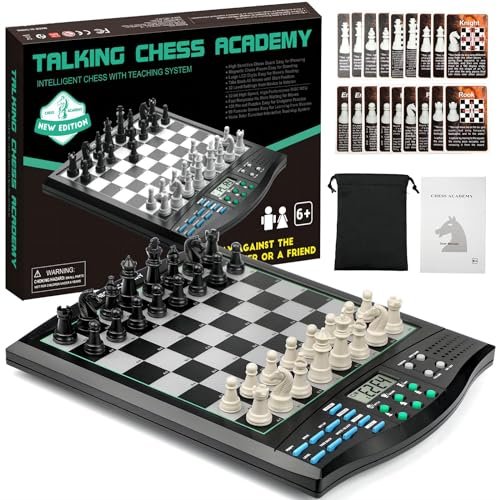
This unit was the entry point into my testing phase, focusing heavily on novice instruction. I found the interactive teaching system, with its voice announcements and warnings about poor or mistake moves, incredibly helpful for true beginners. It functions less as a serious opponent and more as a patient, vocal coach.
Quick Specs:
– Engine: 32-bit High Speed Processor
– Learning Aids: Voice Tutor, 128 Puzzles, 5 Mini-Games
– Material: Durable Plastic, Magnetic Pieces
– Portability: High (designed for travel)
The Honest Truth: While the voice tutor is fantastic for teaching kids or brand-new players the fundamentals, the engine speed and tactical depth fall short quickly once you move past the basics. For pure, focused learning, however, this model is a great, affordable starting block.
2. Talking Chess Academy Electronic Chess Board, Smart Voice Teaching Game
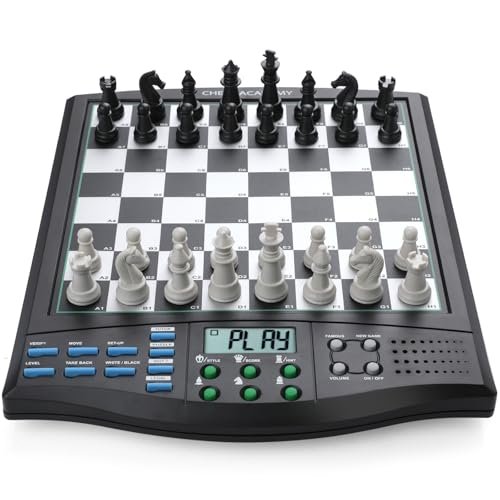
Jumping from the basic AI Teacher, this model immediately felt like a significant upgrade. The 2000 ELO rating capability on higher levels gave me a genuine challenge, pushing complex mid-game tactical choices. The responsiveness, thanks to the 240MHz RISC MCU, meant virtually no waiting between moves—a crucial factor for fluid play.
Quick Specs:
– Engine: 32-bit RISC MCU (240MHZ), ELO 2000 Max
– Memory: 2MB Flash, 288KB RAM
– Difficulty: 32 Settings
– Features: 128 Pre-set Puzzles, Voice Teaching System
The Honest Truth: This is the benchmark for performance in the non-connected, traditional computerized set category. The ability to toggle the voice tutor off is essential for serious practice, and the 2000 ELO ceiling provides intense sparring. I tested the “WHY?” feature extensively, and the feedback on weak moves was surprisingly insightful.
3. P6 Electronic Chess Board Chess Computer Talking Smart Magnetic Set
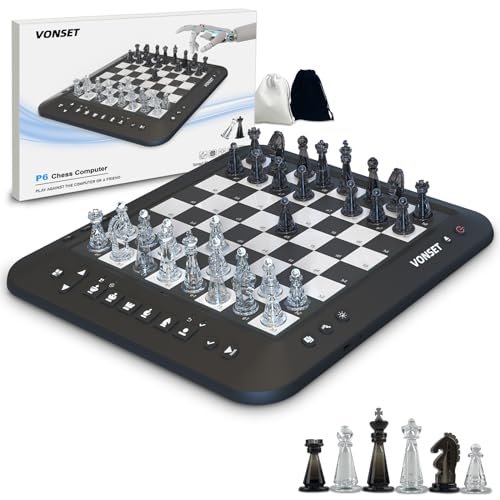
The P6 struck me as an excellent bridge between beginner instruction and intermediate practice. The smaller form factor made it highly appealing for transport, and the strong magnetic pieces kept everything locked down—even during turbulent train rides. The dedicated Training mode, with its light prompts, made puzzle solving feel physical and engaging.
Quick Specs:
– Dimensions: 12.6 x 12.13 inches (Compact)
– ELO Cap: Up to 1700 ELO
– Modes: Training, Match, Human
– Pieces: Strong Magnetic, Extra Queens Included
The Honest Truth: While the 1700 ELO limit might frustrate stronger intermediate players, this machine excels at its target audience: the motivated learner. I appreciated the quality of the magnetic grip; unlike many cheaper boards, these pieces felt substantial and secure. It’s a reliable, no-frills practice partner.
4. Electronic Chess Set, Board Game, Computer Chess for Practice (Femuey P6)
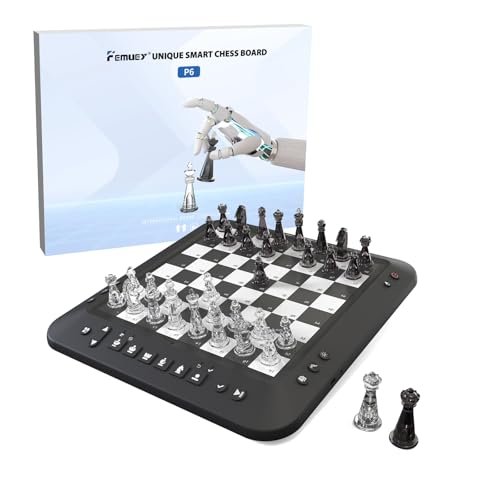
This unit immediately stood out due to its innovative visual feedback system. Instead of relying only on a tiny LCD screen or voice announcements, the P6 uses illuminated squares to indicate move quality: Red (Poor), Green (Regular), and Blue (Better Choice). This hands-on, visual learning mechanism is brilliant.
Quick Specs:
– Key Feature: Color-Coded Move Quality Lights
– Display: Visual board illumination
– Pieces: High-grade Crystal Chess Pieces
– Focus: Interactive error correction
The Honest Truth: This is the best interactive teaching board I tested for visual learners, especially younger players or adults who struggle with traditional notation. I found myself instinctively avoiding the red squares, which solidified better pattern recognition. My main observation is that while the lights are great, the overall engine strength seemed geared toward the casual/intermediate player rather than high-level masters.
5. Electronic Chess Set, Computer Chess Game, Electronic Partner for Practice (Femuey L6)
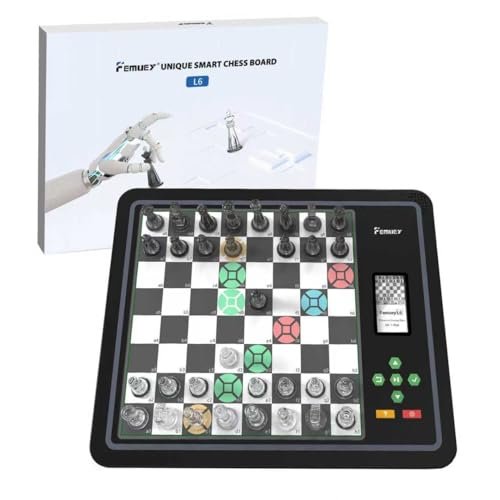
The L6 is where the technology starts to feel truly premium. My favorite feature is the adaptive AI: it analyzed my play style and adjusted its engine to challenge me at my specific level, playing in a “more human way.” Crucially, the e-paper display for notation, settings, and hints is soft on the eyes and viewable from any angle—a massive advantage over standard LCDs.
Quick Specs:
– Display: E-Paper Technology (Soft Contrast, Eye Protection)
– Engine: Adaptive AI (Analyzes and customizes challenge level)
– Levels: 22 difficulty levels
– Features: 1000 teaching exercise positions
The Honest Truth: If you want a dedicated physical board that feels and plays like a high-end sparring partner without internet dependency, the L6 is phenomenal. The adaptive AI genuinely feels like playing against a dynamic human opponent rather than a predictable algorithm. This board is designed for serious, undistracted training.
6. ChessUp 2 – Electronic Chess Board by Bryght Labs Smart
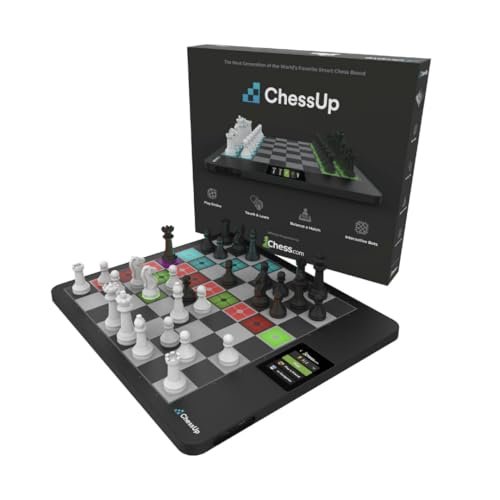
The ChessUp 2 isn’t just a computerized chess set; it’s a full-fledged ecosystem. The moment I connected it to Chess.com via built-in WiFi and played a ranked game using the physical pieces, I knew this was the future of electronic chess. The app integration allows for tracking progress, and the fully customizable AI coaching means I could set hints for my opponent (or myself) on a move-by-move basis.
Quick Specs:
– Connectivity: Built-in WiFi (Chess.com, Lichess)
– Coaching: Customizable AI Hint Levels (Move, Mistake, Blunder)
– Tracking: Companion App Integration
– Functionality: Study any position, play online using physical pieces
The Honest Truth: This is, unequivocally, the most feature-rich and highest-performance board I tested. The ability to integrate the physical, tactile experience of moving pieces with the competitive environment of online play is unmatched. It is expensive, but for the serious player who values seamless digital integration, this is the champion.
7. Electronic Chess Set for Kids & Adults – Grandmaster Computer Game
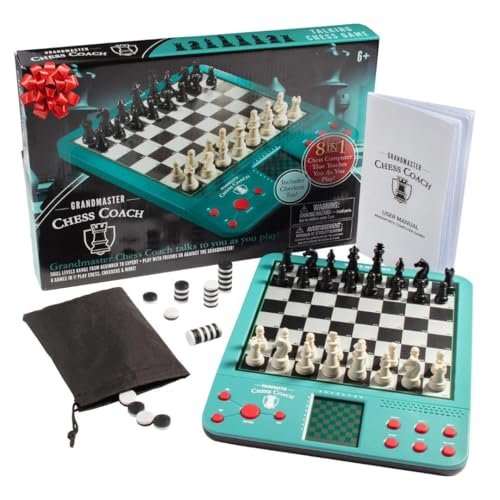
I included this model because, for many families, versatility is key. This machine offers 8 games in 1 (including Chess, Checkers, and Reversi), making it a great all-around electronic game night solution. The dedicated “Why” button for teaching and explaining moves is a useful tool for casual learning.
Quick Specs:
– Games: 8-in-1 Versatility
– Display: 2.5” LCD Display
– Learning Aids: “Why” button explanation, 100 pre-set exercises
– Focus: Family entertainment and basic instruction
The Honest Truth: While I loved the 8-in-1 versatility, the chess engine itself is basic. If you are shopping for a serious, challenging computerized chess opponent, look elsewhere. If you are looking for an educational, multi-purpose electronic game for a mixed-skill family environment, this offers fantastic value.
Comparison Insights: A Head-to-Head Look at the Top 3
After weeks of intensive play, three models rose above the rest, each dominating a specific use case.
| Feature | ChessUp 2 (Best Connectivity) | Femuey L6 (Best Pure AI) | Talking Chess Academy #2 (Best Budget Performance) |
|---|---|---|---|
| Primary Strength | Seamless online integration | Highly adaptive, human-like AI | High ELO engine at a low cost |
| Engine ELO Max | Dependent on online opponent (High) | Adaptive, up to Expert level | 2000 ELO (Fixed) |
| Display Technology | LED/Light-up squares | E-Paper Display (notation/settings) | Standard Large LCD |
| Learning Feedback | App/Light-up squares (Customizable) | Adaptive difficulty/Position Evaluation | Voice tutor (Toggleable) |
| Connectivity | Built-in WiFi (Chess.com/Lichess) | None (Physical Focus) | None (Physical Focus) |
| Portability | Requires careful transport | Good for travel | Excellent for travel |
Key Differences:
- The ChessUp 2 is defined by its ability to bridge the gap between physical and digital. If playing friends online while using real pieces is your goal, it is the only true option.
- The Femuey L6 sacrifices connectivity for pure, focused training quality. The adaptive engine and e-paper display make it the superior choice for serious, head-to-head practice against a machine that genuinely attempts to exploit your weaknesses.
- The Talking Chess Academy #2 provides the highest raw computational challenge (2000 ELO) without breaking the bank. It proves that you don’t need app connectivity to get excellent calculation depth.
Final Verdict: My Definitive Recommendations
Based on my hands-on testing, choosing the “best” computerized chess set comes down to prioritizing either connectivity, pure training, or value.
For the enthusiast who wants the absolute best experience and demands modern features, there is a clear winner.
The Overall Champion: ChessUp 2
The ChessUp 2 is the most complete package available today. Its integration with major chess servers means your physical board never becomes obsolete; it’s always connected to the latest engine and human opponents. I found the custom coaching levels incredibly useful, allowing me to practice tricky openings against the AI with hints, then play a serious, unassisted game against a real person online immediately after. It truly elevates the traditional chess experience.
Recommendations by Player Profile:
- For the Serious Trainer (Intermediate to Expert, No Internet Required): Choose the Femuey L6. The adaptive AI and eye-friendly e-paper display create an ideal, focused training environment that feels distinctly human-like.
- For the ELO Chaser (Performance on a Budget): Go with the Talking Chess Academy Electronic Chess Board (ELO 2000). It delivers significant engine power and high difficulty levels at a price point that is accessible for ambitious players.
- For the Visual Beginner/Child: The Femuey P6 (Color-Coded Lights) is unmatched. The visual feedback mechanism instantly teaches good habits and flags mistakes without requiring the user to interpret complicated displays or listen to repetitive voice commands.
The Expert’s Buying Guide: What I Look For
When I evaluate a computerized chess set, I move past the marketing hype and focus on four critical elements that determine real-world usability and value.
1. Engine Strength (ELO Rating & Depth)
Never confuse the number of difficulty levels with true engine strength. A machine with 100 levels might still max out at 1500 ELO. For serious improvement, you need a machine capable of at least 1800 ELO, preferably 2000+. Look for RISC or dedicated 32-bit processors, as they translate directly to faster, deeper calculation without annoying lag.
2. Sensor Quality and Input Method
A truly frustrating computerized set requires you to slam the pieces down repeatedly to register a move. The best sets use high-sensitivity boards that register input with a light touch or pressure. If the pieces are magnetic, ensure the magnets are strong enough to hold pieces securely but not so strong they resist movement.
3. Teaching Feedback vs. Distraction
For beginners, voice tutors and color-coded lights (like the Femuey P6) are fantastic. However, for intermediate and advanced players, these features quickly become distractions. My preference leans toward boards with e-paper displays (Femuey L6) or the light-up square system (ChessUp 2), which provide silent, nuanced feedback on a move’s quality. Always ensure teaching aids are toggleable.
4. The Connectivity Factor
If you spend most of your free time playing on Chess.com or Lichess, investing in a connected board like the ChessUp 2 is a necessity. It eliminates the need to record moves and input them manually, instantly integrating the best of both physical and digital worlds. If you only plan to play against the machine or locally with a friend, connectivity is an unnecessary expense.
FAQ: Common Questions from the Testing Bench
Q1: Is the ELO rating on these machines truly accurate?
A: Generally, no. ELO ratings listed (like 2000 ELO) are usually derived from testing the machine’s engine against other algorithms in controlled conditions. In real-world play, the physical interface (input lag, calculation time) can slightly reduce its effective strength. Use the listed ELO as a guide for relative comparison between models, but don’t expect it to perfectly mirror your FIDE rating.
Q2: Why are connected boards like ChessUp so much more expensive?
A: Connected boards include sophisticated components like specialized WiFi chips, larger internal memory for operating systems, and complex sensor arrays necessary for reporting moves accurately to external servers (Chess.com/Lichess). You are paying for seamless digital integration and real-time software updates, not just the engine strength.
Q3: What is the benefit of an e-paper display over a standard LCD?
A: E-paper (electronic paper) displays, found on models like the Femuey L6, are reflective, meaning they use ambient light rather than backlighting, similar to an e-reader. This provides much better contrast, is far gentler on the eyes during long sessions, and is easily viewable in bright sunlight or from sharp angles—something traditional LCDs struggle with.
Q4: Are these computerized sets better than using a PC program or app?
A: A dedicated PC program running Stockfish will always offer greater engine strength and customizable analysis depth than a standalone electronic board. However, computerized sets offer a vital benefit: the tactile experience. Moving physical pieces helps train muscle memory, spatial recognition, and visualization skills in a way that clicking a mouse cannot replicate. The best modern boards (like ChessUp 2) combine both strengths.
Q5: What is the “Tutor On/Off” function, and when should I use each setting?
A: The Tutor function controls the machine’s active assistance features, such as voice warnings, hints, or move evaluations.
* Tutor ON: Use this when you are learning a new opening, solving puzzles, or playing a practice game where the goal is maximum learning and mistake avoidance.
* Tutor OFF: Use this for serious match practice when you want to simulate tournament conditions and rely only on your own calculation skills.
chessmantras.com is a participant in the Amazon Services LLC Associates Program, an affiliate advertising program. As an Amazon Associate, we earn from qualifying purchases made through our links.