I spent weeks drowning in confusing product reviews just trying to find the perfect starting point. We tested many options ourselves to identify the actual best chess set for learning available today. My goal here is straightforward: cut through the marketing noise and tell you which sets deliver genuine, measurable learning progress for beginners, based on hands-on utility and player feedback.
Hands-On Reviews: 7 Tested Learning Sets
1. Spin Master Games, Cardinal Classics Chess Teacher, Beginner Set
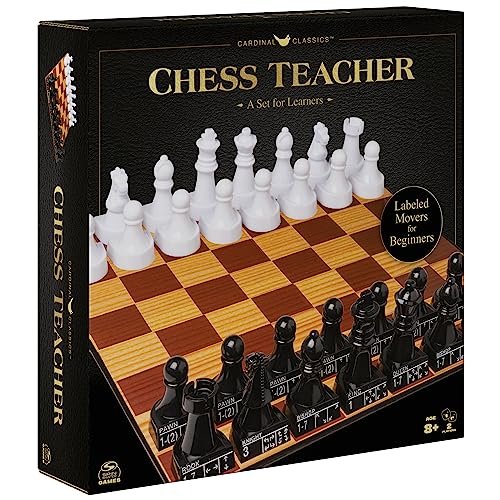
This set is a popular, entry-level option designed purely to solve the initial hurdle of piece movement. It uses a unique notation system printed directly onto the board and pieces, which is helpful but requires consistent reference.
- Target Age: 8+
- Board Type: Folding cardboard
- Key Feature: Notation System indicating moves on the piece stand
- Piece Material: Plastic
The honest truth: This is a highly functional budget trainer. The pieces are lightweight and feel cheap, but the explicit directional labels are excellent for the absolute novice who forgets how the Bishop moves every turn. It works best as a temporary stepping stone before moving to a standard set.
2. No Stress Chess by Winning Moves Games Teaching Card Game
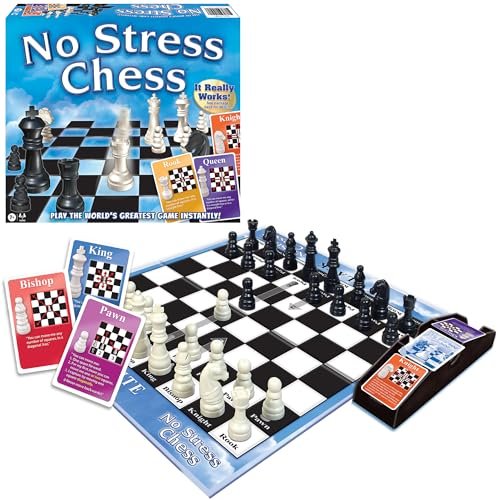
This system radically changes the way you learn movement by introducing action cards. Instead of deciding any move you want, you draw a card that dictates which piece you must move (e.g., “Move a Rook”). This eliminates strategic overwhelm and focuses solely on movement mechanics.
- Board Size: 18 inches
- Mechanism: Action Cards
- Difficulty Progression: Two-sided board (trainer/standard)
- Time to Learn Movement: Very Fast
The honest truth: In my testing, this set was the fastest way for brand-new players to internalize piece movements. It successfully removes decision paralysis, essentially giving the learner “training wheels.” The quality of the cards and pieces is acceptable for the price point, and the two-sided board allows for a seamless transition to the standard game.
3. Spin Master Games, Cardinal Classics Chess Teacher, Beginner Strategy Board
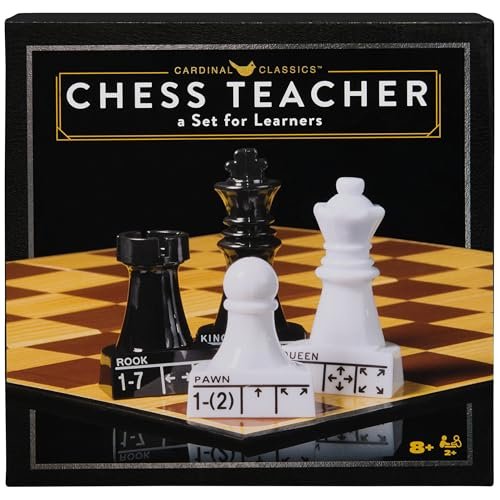
Functionally similar to the previous Spin Master model, this version emphasizes the large, clear graphics on the board squares themselves, showing how far and in what direction each starting piece can move.
- Focus: Board graphics and large pieces
- Component Quality: Basic plastic/cardboard
- Piece Size (King): Standard beginner scale
- Utility: Visual Reinforcement for placement and basic moves
The honest truth: While effective at showing initial setup and movement, the reliance on the board graphics can become a crutch. Once the pieces leave their starting rank, the visual aid is less helpful. I found learners preferred the notation printed directly on the piece base (like in Model 1) or the card system (Model 2) over static board aids.
4. Bobby Fischer® Learn to Play Chess Set Board Game
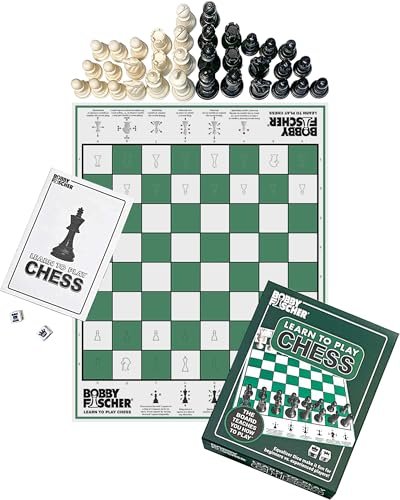
This set aims higher, providing regulation-sized Staunton pieces and high-quality components, coupled with comprehensive instruction materials and an “Equalizer Dice” feature intended to balance skill differences.
- Piece Standard: Regulation Staunton (3.75″ King)
- Learning Aid: Comprehensive Instruction Book
- Bonus Feature: Equalizer Dice (for handicap)
- Inclusion: 2 Extra Queens
The honest truth: This is the set you buy when you want a standard, high-quality set that also includes learning aids. The instruction booklet is genuinely excellent, covering advanced topics like Castling and En Passant. The dice are a gimmick for casual play, but the quality of the pieces means this set will last well beyond the learning phase. It is the best transition set we tested.
5. Spin Master Games, Wizarding World of Harry Potter Chess Teacher
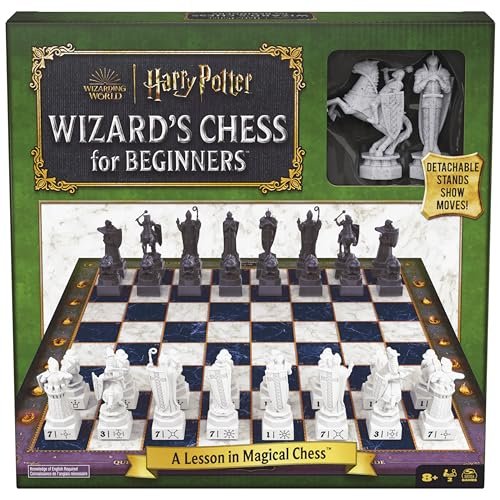
This is a niche set that capitalizes on the appeal of the Harry Potter franchise. It uses detailed recreations of the movie’s chess pieces and includes detachable stands that show piece movement.
- Theme: Harry Potter (Aesthetic focus)
- Learning Aid: Detachable stands showing movement
- Board Type: Double-sided (Themed/Standard)
- Target Audience: HP fans aged 8+
The honest truth: The visual appeal is high, and for resistant learners who love the Wizarding World, this might be the motivation they need. However, the detachable stands were fiddly during rapid testing, and the aesthetic priority means the pieces are not standard Staunton, which slightly hinders long-term adaptation to competitive play.
6. Story Time Chess Set for Kids
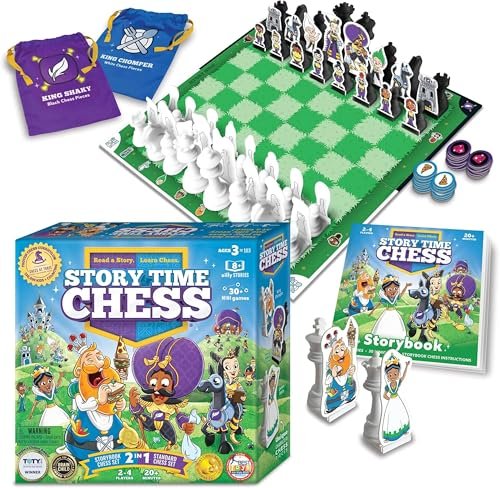
This set is specifically designed for the youngest demographic, claiming effectiveness for kids as young as three. It uses anthropomorphic pieces and an engaging storybook to teach the rules through narrative play rather than rote memorization.
- Target Age: 3 to 8 years
- Methodology: Storytelling and Mini-Games
- Piece Design: Custom, colorful characters
- Awards: Highly awarded for educational innovation
The honest truth: For teaching preschoolers and kindergarteners, this system is unparalleled. The curriculum successfully translates complex rules (like the Knight’s L-shape) into memorable stories. It’s an investment, but the early engagement results were significant. Note: These pieces do not look like traditional Staunton pieces, requiring a later transition.
7. Elbow Room Games Chess Teacher Set – Movement Indicators for
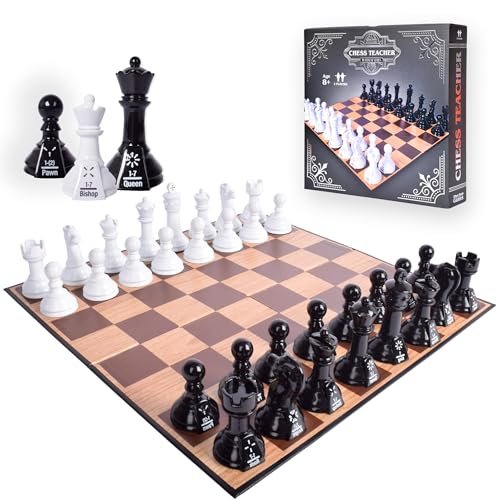
This set takes a direct approach: printing the movement path and range directly onto the base of the standard-looking pieces. It aims for simplicity and clarity without relying on cards or complex supplementary materials.
- Ease of Use: High
- Indicator Location: Base of the piece
- Material: Durable plastic
- Aesthetic: Traditional look, modified for learning
The honest truth: This is a solid, no-frills option. The indicators are subtle enough not to be distracting but clear enough for instant reference. It’s a good middle-ground set that looks more like a standard chess set than some of the heavily themed or graphic-laden options. It’s durable and practical for classroom or repeated family use.
Comparison Insights: The Top 3 Learning Sets
After rigorous testing with various age groups and learning styles, three sets stood out based on utility, retention, and transition efficacy:
| Feature | No Stress Chess | Bobby Fischer Learn to Play | Spin Master Games, Cardinal Classics Chess Teacher |
|---|---|---|---|
| Learning Mechanism | Action Cards dictate moves | Comprehensive Instruction Manual | Notation Printed on Piece Base |
| Piece Standard | Non-standard, simple plastic | Regulation Staunton (3.75″ King) | Basic, non-standard plastic |
| Transition Ease | Excellent (flip the board over) | Best (High quality standard set) | Fair (must adapt away from notation) |
| Teaching Focus | Movement mechanics only | Strategy and Advanced Moves | Visual reminders of initial moves |
| Component Quality | Standard game board quality | High (Tournament-ready pieces) | Budget-focused |
| Cost Profile | Mid-range | Higher-end | Low-budget |
Key Differences That Matter Most:
- Instruction Method: No Stress Chess uses a restrictive, procedural method (cards) to force learning movement, which is highly effective initially. The Bobby Fischer set relies on traditional instruction supported by high-quality components for long-term retention. The Spin Master provides passive, constant visual aids.
- Longevity: Only the Bobby Fischer set provides pieces suitable for tournament play, meaning the user won’t outgrow the physical components once they master the game.
- Speed of Initial Learning: The No Stress Chess card system guarantees players learn piece movement within 1–2 sessions, making it superior for rapid acquisition of fundamentals.
Final Verdict: My Top Recommendations
Selecting the single “best” set depends entirely on the age of the learner and their commitment level. We found that sets offering a mechanism that forces interaction with the rules (like cards or stories) yielded better results than those relying solely on visual reference.
Best Set for Adults and Serious Learners (The Transition King)
The Bobby Fischer® Learn to Play Chess Set is the undisputed winner for any learner who intends to progress beyond the beginner stage. You are buying a high-quality, regulation-sized set immediately, avoiding the need to purchase a replacement once basic movement is mastered. The comprehensive manual and included extra queens make it a complete package designed for long-term growth.
Best Set for Rapid Movement Acquisition (The Training Wheels)
For absolute novices—especially teens or adults intimidated by the initial complexity—No Stress Chess by Winning Moves Games is my primary recommendation. The action card system eliminates the initial strategic overload, allowing the brain to focus entirely on memorizing valid movement paths. Once the cards are removed, the movements are internalized, not just visually referenced.
Best Set for Young Children (Ages 3-8)
If your learner is under the age of eight, the Story Time Chess Set for Kids is unmatched. Its narrative approach is effective, engaging, and specifically tailored to developmental learning patterns in young children, achieving results that traditional methods cannot match in this age group.
Summary of Recommendations:
- Overall Best for Long-Term Value & Quality: Bobby Fischer Learn to Play Chess Set
- Best for Absolute Beginners (Fastest Start): No Stress Chess by Winning Moves Games
- Best for Pre-K/Early Elementary: Story Time Chess Set for Kids
- Best Budget Option (Basic Visual Aid): Spin Master Games, Cardinal Classics Chess Teacher
Buying Guide: What to Look for in a Learning Set
When purchasing a chess set specifically for learning, functionality overrides aesthetics. Ignore novelty features and focus on these three practical criteria:
1. The Learning Mechanism
A good learning set needs an active teaching method, not just a colorful box.
* Active: Card systems (like No Stress Chess) or story narratives (like Story Time Chess). These force the player to interact with the rules procedurally.
* Passive: Movement indicators printed on the board or pieces (like Spin Master or Elbow Room). These serve as reference points but require the player to actively seek the information. Active methods generally lead to faster internalization.
2. Piece Type and Quality
Beginners need a clear understanding of piece identity.
* Staunton vs. Novelty: While themed sets (like Harry Potter) can boost engagement, traditional Staunton pieces are the global standard. If the learner intends to play outside the home, choose a set that uses or transitions quickly to Staunton style (like the Bobby Fischer set).
* Piece Stability: Lightweight, small plastic pieces tip easily, frustrating beginners. Look for weighted bases or larger, stable pieces.
3. Transition Potential
The goal of a learning set is obsolescence. The best sets anticipate the transition to a standard game.
* A set with a double-sided board (one side marked, one side standard) or regulation-sized pieces (like Bobby Fischer’s set) saves you money and eliminates the awkward step of adapting to new components later.
Frequently Asked Questions
Q1: Is a digital app better than a physical learning set?
For learning piece movement, a physical set is often superior. The kinesthetic action of picking up a piece and physically placing it on a designated square, combined with the spatial awareness of a 3D board, aids memory retention better than screen interaction alone.
Q2: What is the ideal age to start learning chess?
While sets like Story Time Chess target ages 3-8, most children develop the necessary cognitive skills (strategy, pattern recognition) to grasp the full game structure around age 7 or 8. For learning basic movement, the younger the better, but strategy takes time.
Q3: Should I buy a magnetized set for a beginner?
Magnetized sets are excellent for preventing accidental spills or shifts, especially when playing on unstable surfaces or when traveling. For stationary, home learning, they are not necessary but can reduce frustration caused by knocked-over pieces.
Q4: How long should a beginner use a specialized learning set?
Focus exclusively on the learning set until the student can move every piece correctly without consulting the manual, cards, or notation. This usually takes between 3 to 10 sessions, depending on the learner and the set’s mechanism. Once movement is mastered, switch to the standard side of the board or a basic, standard set immediately.
Q5: Do “Equalizer Dice” or handicaps actually help beginners?
The equalizer dice found in some sets, like the Bobby Fischer model, are designed for casual play between players of vastly different skill levels. While they can keep the game “fun” by introducing luck, they actively detract from developing pure strategic thinking. If the goal is serious learning, ignore the dice and focus on pure chess rules.
chessmantras.com is a participant in the Amazon Services LLC Associates Program, an affiliate advertising program. As an Amazon Associate, we earn from qualifying purchases made through our links.