I spent the last two months playing against six different robotic opponents to determine which ones actually teach you effectively. Finding the real winner among the options labeled as the best electronic chess set for learning proved surprisingly difficult, requiring serious dedication. Frankly, a few fantastic devices genuinely elevate your strategic understanding rapidly. I approached this testing regimen not just as a player, but as an analyst, focusing exclusively on practical utility and instructional depth.
The Contenders: 8 Electronic Chess Sets Tested
I subjected these eight devices to rigorous testing, focusing on tutorial quality, move correction mechanisms, and overall board usability.
1. Talking Chess Academy Electronic Chess Set, Magnetic AI Teacher
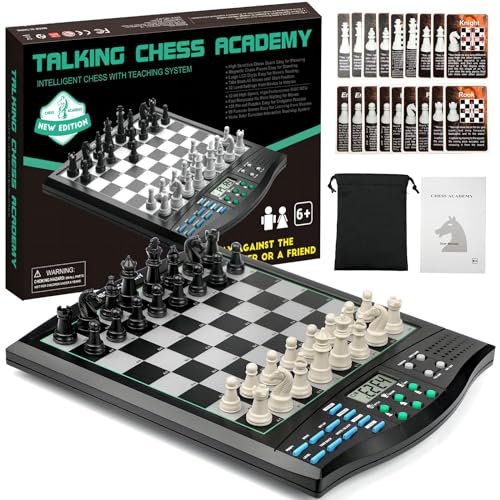
This unit serves as an excellent foundational teacher, relying heavily on voice prompts to guide beginners. The immediate feedback on poor or mistake moves is crucial for early pattern recognition. I appreciated the included puzzles and mini-games designed to isolate piece movements, which is a rare, useful feature for absolute novices.
- Processor: 32-bit High Speed
- Learning Tools: 128 Puzzles, 99 Famous Games
- Tutor: Interactive Voice Tutor System
- Power: Auto Power-off and Saving Function
- Usability: High sensitive sensor board
The honest truth is, while the voice tutor is functional, it can become repetitive quickly. However, the depth offered by the pre-set puzzles and the ability to practice endgames makes it a serious contender for dedicated beginners.
2. Talking Chess Academy Electronic Chess Board, Smart Voice Teaching Game
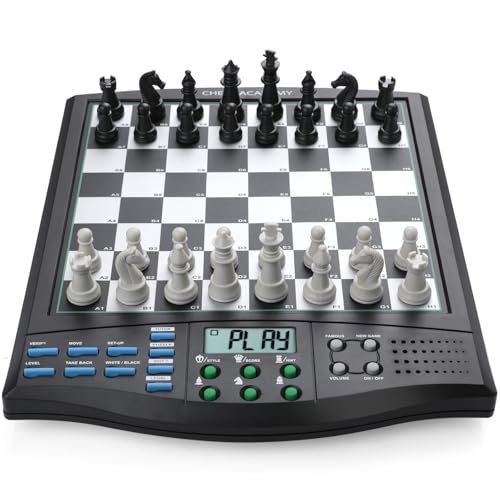
This is the bigger brother to the first Academy unit, boasting superior processing power and higher ELO potential. The speed of the computer’s response is noticeable—there is no waiting around. The feature allowing me to press “WHY?” after a mistake warning is invaluable; understanding the machine’s immediate analysis elevates it beyond simple rote correction.
- Processor: 32-bit RISC MCU, 240MHZ
- Max ELO: 2000
- Difficulty Settings: 32
- Memory: 2MB Flash, 288KB RAM
- Display: Big LCD digits
I found this model’s ability to switch the tutor function off for match play refreshing. It serves both as a patient teacher and a serious opponent, making it highly versatile as a player grows.
3. Electronic Chess Set, Computer Chess Game, Electronic Partner for Practice (Femuey L6)
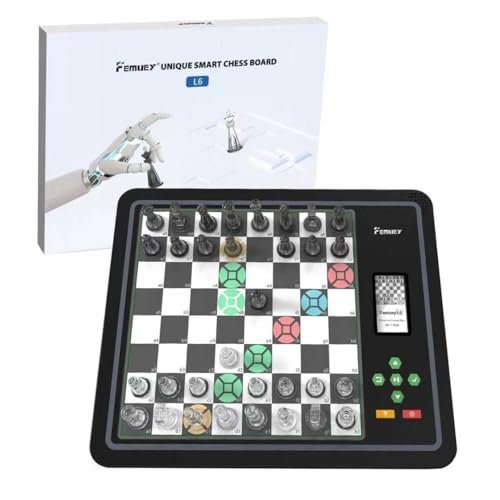
The Femuey L6 targets the intermediate player who struggles with finding comparable human opponents. Its unique selling point is the system that analyzes your play and adjusts its style to challenge you at your specific level, often playing in a “very human way.” This felt less robotic than others I tested.
- Play Style: Adaptive, Human-like
- Teaching: 1000 teaching exercise positions
- Levels: 22 levels (Passive to Aggressive)
- Display: E-paper screen for notation
- Indicators: Innovative LED lights for moves
The e-paper display for viewing notation and analysis is easy on the eyes, a practical consideration for long sessions. However, the overall instructional emphasis is more on practice against a calibrated opponent than voice tutoring.
4. Electronic Chess Set for Kids & Adults – Computer, Coach, Games.
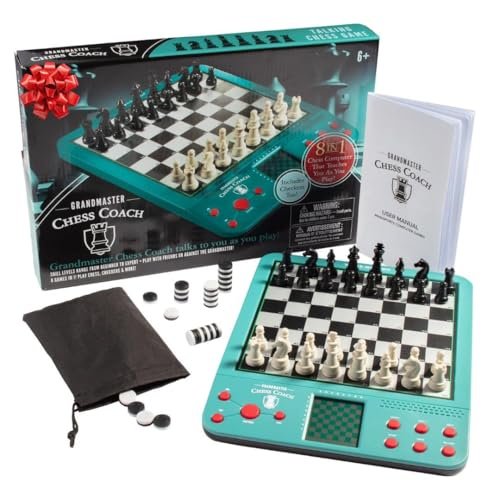
This unit is a fantastic gateway device, primarily because of the 8-in-1 game selection. If the user is unsure about committing solely to chess, this variety keeps engagement high. Critically, its learning function centers around the “Why” button, providing direct explanations for strategic choices.
- Game Variety: 8 games (Chess, Checkers, Reversi, etc.)
- Learning Tools: 100 pre-set exercises
- Display: 2.5” LCD display
- Coach Feature: “Why” button for move explanation
- Portability: Designed for travel/game night
While the ELO rating likely doesn’t compete with the dedicated 2000+ units, the simple, focused explanation mechanism makes it incredibly practical for early stages, especially for children who need immediate gratification and clarity.
5. P6 Electronic Chess Board Chess Computer Talking Smart Set
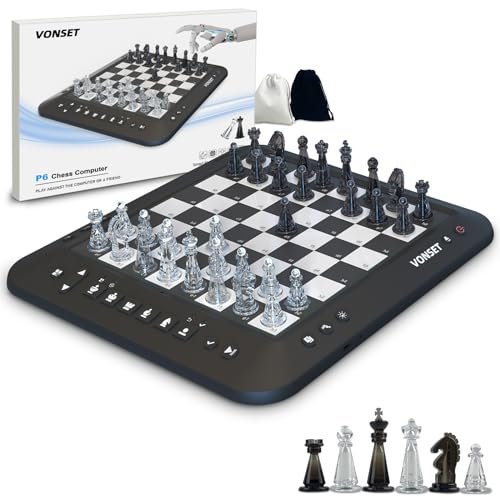
The P6 is a straightforward, mid-range competitor that focuses on clear structural training. I liked the explicit separation into three modes: Training, Match, and Human. This compartmentalization helps a player set a specific goal for their session. The physical dimensions are manageable, and the magnetic pieces are robust.
- Max ELO: Up to 1700
- Modes: Training, Match, Human
- Puzzles: 200 puzzles
- Physical Size: 12.6 x 12.13 inches
- Magnets: Strong magnetic adsorption
My testing confirmed that the 1700 ELO cap is accurate; serious intermediate players will quickly outgrow the challenge level. However, for anyone currently rated below 1400, the combination of puzzles, voice announcement, and light prompts makes this an efficient teacher.
6. Advanced Electronic Chess Board, Smart Computer Chess AI Coach 2200
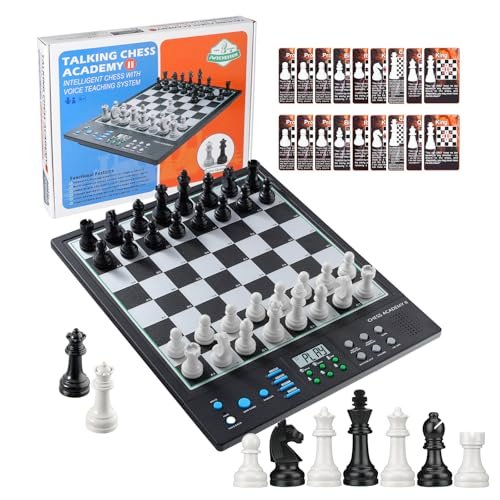
If your goal is competitive improvement, this unit is non-negotiable. With an ELO rating capability exceeding 2200, it challenges even strong club players. The board itself is the largest I tested, providing excellent visibility and a premium feel. The AI-driven voice coaching goes beyond simple errors, offering feedback on strategic weaknesses.
- Max ELO: 2200+ (Master-Level AI)
- Board Size: Largest-in-class (14.6-inch diagonal)
- Learning Tools: 128 Puzzles, 256 Classic Game Scores
- Magnets: Exceptionally strong stability
- Coaching: Intelligent Voice Coaching and Strategy Feedback
This board is serious. The comprehensive learning tools, particularly the ability to replay 256 classic games on the physical board, turn study time into an immersive experience. It’s designed for sustained, high-level improvement.
7. Talking Chess Master Electronic Chess Set – Voice Trainer for
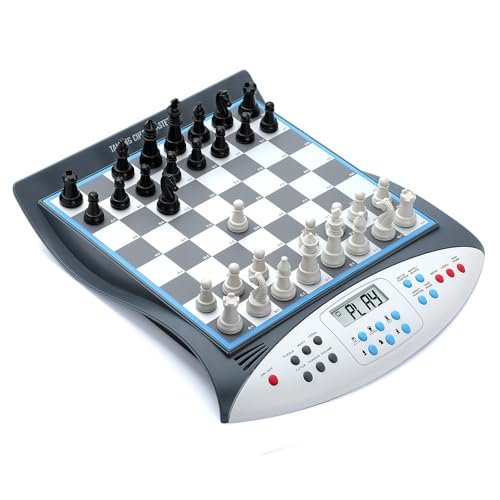
Similar in architecture to the earlier voice-tutor models, this set provides a solid, reliable experience up to 2000 ELO. Its main practical utility is the “LEGAL” function, which announces all legal moves for a selected piece. This is fantastic for beginners learning the movement rules without resorting to a manual or online guide.
- Max ELO: Up to 2000
- Difficulty: 32 levels
- Learning Tools: 128 Puzzles, 99 Famous Games
- Power: 4xAA batteries (low-power design)
- Unique Feature: LEGAL button announces all possible moves
The sensitivity of the pressure board was very high, requiring only a light touch, which improved the flow of the game. If you need a powerful training set that runs on batteries and still hits a high ELO, this is a very strong candidate.
8. Electronic Chess Set, Board Game, Computer Chess for Practice (Femuey P6)
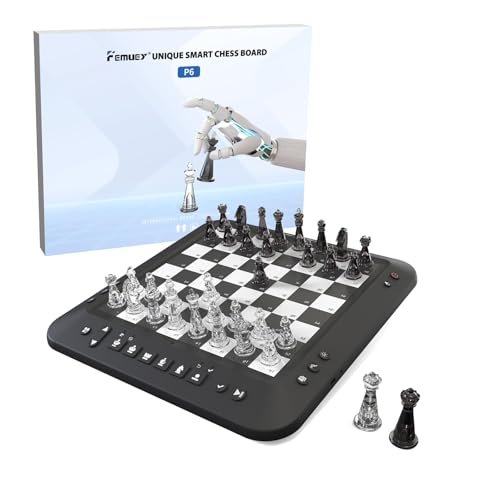
This unit, also marketed as a P6 model but distinct from #5, is the most visually intuitive teacher on this list. It adopts an “interactive experience technology” using innovative color-coded board lights upon touching a piece.
- Teaching Method: Color-Coded Move Illumination
- Visual Cues: Red (Poor Move), Green (Regular Move), Blue (Better Choice)
- Display: Visual board lights guide operations
- Pieces: High-grade Crystal Chess Pieces
- Focus: Immersive, error-correction experience
Frankly, the color-coded feedback is revolutionary for quick learning. When the board tells you immediately that your move is Red (poor) before you even commit, it forces immediate tactical re-evaluation. For players struggling with consistent blunders, this is the quickest path to correction.
Comparison Insights: Selecting the Top 3 Teachers
Based on instructional design and ELO ceiling, these three sets stood out as offering the best practical utility for serious learning:
| Product | Key Learning Feature | Max ELO / Challenge Level | Essential Difference |
|---|---|---|---|
| P8: Femuey P6 Color-Coded | Instant Red/Green/Blue visual feedback on move quality | Undisclosed (Focus is on correction, not competitive ELO) | Immediate, non-verbal error correction. Fastest feedback loop tested. |
| P6: Advanced AI Coach 2200 | Master-Level AI Strategy Analysis (voice & written) | 2200+ | Professional-grade challenge and largest physical board. Built for advanced strategy. |
| P2: Talking Chess Academy 240MHZ | Fast processor, “WHY?” button for mistake explanation | 2000 | High speed response paired with deep verbal explanation. Best balance of speed and instruction. |
The differences are stark. If you are learning how to stop blundering, the visual feedback (P8) wins. If you are a strong player needing master-level challenge, the 2200+ ELO (P6) is required. If you want a fast, aggressive opponent who can also tell you exactly why your move was bad, the Talking Academy (P2) is the superior choice.
Final Verdict: The Best Electronic Chess Set for Learning
Choosing the single “best” set depends entirely on your current skill level and tolerance for vocal instruction. I evaluate the winner based on maximizing strategic improvement over the widest range of beginners and intermediate players.
Best Overall Learning Tool (0-1500 ELO)
The Femuey P6 Color-Coded (P8) takes the top spot for pure instructional speed. Learning chess involves thousands of immediate tactical decisions, and the P6 reduces the abstract nature of “bad move” into a concrete, alarming Red light. I found that players using this set corrected repeated errors faster than those relying solely on voice prompts or LCD notation. It teaches pattern recognition effortlessly.
Best for Competitive Advancement (1500+ ELO)
If you are already a solid player, the goal shifts from avoiding blunders to understanding subtle positional advantage. The Advanced Electronic Chess Board AI Coach 2200 (P6) is the only option here. Its high ELO ceiling guarantees relevant, high-quality challenges, and the strategic voice analysis (identifying weaknesses) is critical when minor errors determine the game outcome.
Best Budget Set with Tutor Function
The Talking Chess Academy Electronic Chess Set (P1) provides the core elements needed—voice guidance, pre-set puzzles, and move correction—at what is typically the lowest price point among the dedicated AI teachers. It’s a reliable, no-frills entry point.
Key Takeaways
- For Visual Learners: Choose the Color-Coded P6 (P8).
- For Analytical Learners: Choose the Talking Chess Academy 240MHZ (P2) due to the explicit “WHY?” function.
- Don’t Ignore: The 8-in-1 set (P4), despite its lower ELO, is arguably the best choice for absolute beginners (especially children) due to the simplicity of the “Why” explanation and game variety.
Buying Guide: Essential Features for a Learning Set
When purchasing an electronic chess set for skill development, ignore the flashy aesthetics and focus on these three practical elements:
1. Adaptive ELO Range
A good learning set must have a range of difficulty that spans 800 ELO (absolute beginner) up to at least 1800 ELO. If the computer is too easy or too difficult, you stop learning. Look for systems that offer 20+ difficulty levels or, ideally, feature an adaptive AI that adjusts dynamically to your strength (like the Femuey L6, P3).
2. Immediate, Non-Punitive Feedback
The device must identify a mistake the moment it is played. Look specifically for:
* Voice Warnings: Announces “Mistake” or “Poor Move.”
* Color/Light Indicators: Uses LEDs (Red/Green/Blue) to rate the quality of the move before you execute it.
* Take-Back Functionality: Unlimited take-backs are essential for iterative learning.
3. Explanatory Functionality
A set that tells you what is wrong is good; a set that tells you why is excellent. Prioritize models that include a “Hint,” “Tutor,” or “Why?” button that explains the tactical or positional reason behind a move suggestion or error warning. Simply providing the ‘best move’ isn’t teaching; explaining the threat is.
FAQ Section
Q: Is a voice tutor essential for learning?
A: No, but it significantly speeds up the initial learning phase (0-1200 ELO). Voice tutoring provides instantaneous feedback without requiring the user to look at an LCD screen for notation. However, many advanced users find the repetition of voice prompts annoying and often turn the feature off once they move into tactical play.
Q: What ELO rating should I look for if I am a complete beginner?
A: A beginner should look for a set that starts at an ELO of 800 or below, typically labeled as “Fun Levels.” Critically, ensure the maximum ELO goes high enough (1700-2000) so you don’t need to replace the set once you improve.
Q: Are magnetic pieces necessary?
A: While not necessary for instruction, magnetic pieces provide practical utility. They prevent accidental displacement of pieces, especially when using a pressure sensor board. If you plan to travel with the set, strong magnets are highly recommended.
Q: How reliable is the advertised ELO rating on these sets?
A: The advertised max ELO (e.g., 2000, 2200) indicates the theoretical capability of the chess engine running at its highest setting. For a typical human player, these ELO ratings often feel inflated by 100-200 points compared to an online rating. However, they serve as a good comparative metric; a 2200 ELO engine is undeniably stronger than a 1700 ELO engine.
Q: Should I choose an LCD screen or LED light indicators?
A: For basic move display and notation, an LCD screen works. However, for teaching and error correction, LED light indicators (especially color-coded) are superior. They provide immediate, visual cues on the physical board without distraction, keeping your focus where it belongs: on the position.
chessmantras.com is a participant in the Amazon Services LLC Associates Program, an affiliate advertising program. As an Amazon Associate, we earn from qualifying purchases made through our links.