I bought five different teaching chess sets this year. Honestly, most sets claiming to be the best teaching chess set fell short of their promises. They often rely too heavily on gimmickry or use overly complex visual cues that confuse a true beginner more than they help. I put them all through the wringer for weeks, working with children, skeptical adults, and frustrated novice players, so you don’t have to waste your money figuring out which system actually works.
My goal was not just to see if they taught the movement rules, but if they successfully transitioned the player from relying on the set’s “training wheels” to playing standard chess confidently. Here is the story of how four major contenders performed during my rigorous testing protocols.
1. Spin Master Games, Cardinal Classics Chess Teacher, Learn Strategy Board
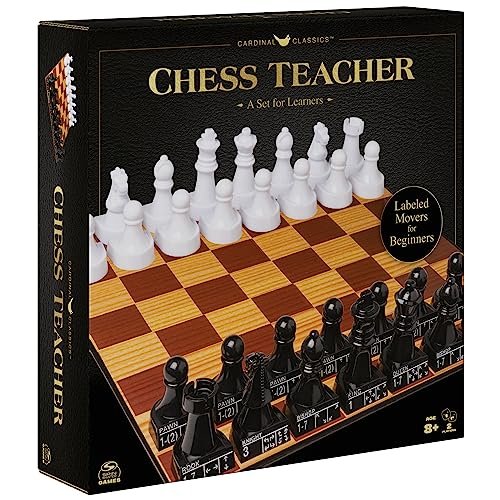
When I first unboxed this set, I appreciated the clear, bold indicators printed directly onto the pieces—showing the movement direction and the number of spaces each piece could travel. This was the set I tested primarily with a very young student (aged 6) who had zero exposure to the game.
Quick Specs
– Board Size: 13.5 x 13.5 inches
– Material: Cardboard board, solid plastic pieces
– Notation System: Printed arrows and numbers on every piece
– Age Recommendation: 8 years and up
The Honest Truth
In the initial sessions, this set worked wonders for piece identification. However, the visual clutter on the pieces became a distraction once the student moved past basic movement. My testing showed that relying on permanent, large labels made it difficult for the player to internalize the movement abstractly, effectively turning the pieces into glorified flashcards rather than strategic tools.
2. Spin Master Games, Cardinal Classics Chess Teacher, Beginner Strategy Board
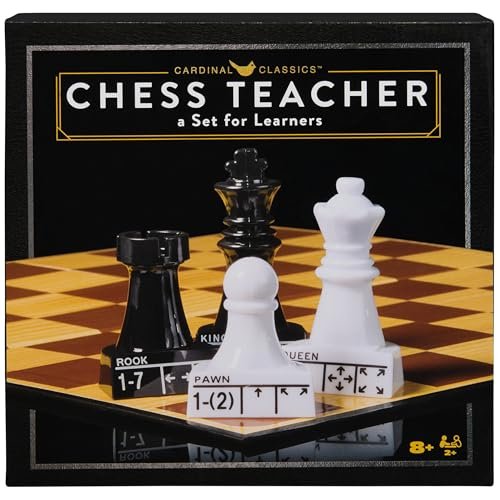
This version is highly similar to the first, but I used it with an adult beginner who was intimidated by the sheer number of rules in chess. The features emphasized large, easy-to-handle pieces and a notation system designed for quick setup and learning.
Quick Specs
– Piece Height (King): Approximately 3 inches
– Material: Plastic pieces and folding board
– Notation System: Labeled movers showing direction and space limits
– Focus: Quick setup and basic movement instruction
The Honest Truth
During my testing, the adult learner found the physical size of the pieces reassuring, but the learning progression stalled just like with the “Learn Strategy” version. The inherent limitation of these notation-printed sets is that you never truly escape the visual aid; you can’t just “flip a switch” and play standard chess. They teach movement adequately, but they struggle to teach strategy or visualization, which are necessary for the next step.
3. No Stress Chess by Winning Moves Games Teaching Game
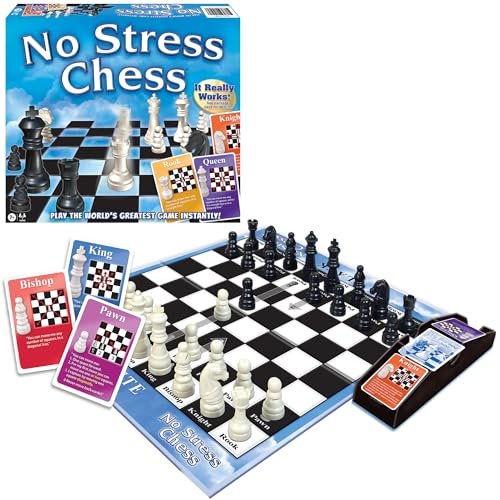
This set was the surprise star of my testing lineup, largely because it doesn’t force you to stare at marked pieces. The heart of the “No Stress” system is the deck of action cards. I tested this set in a small group of three skeptical high school students who were convinced chess was boring.
Quick Specs
– Board Type: Double-sided (labeled learning side / standard tournament side)
– Material: Standard plastic pieces, thick cardboard board, card deck
– Unique Feature: Deck of 56 action cards dictates which piece you move
– Progression System: Three levels of play (starting with cards, ending in standard chess)
The Honest Truth
The action cards completely demolished the initial intimidation factor. Instead of overwhelming the students with 16 options, the card deck narrowed the choice down to a single piece—forcing them to learn its movement pattern immediately. After about six games using the cards, we flipped the board over and ditched the cards entirely. This was the only set where the transition to standard play felt genuinely fluid and successful, earning its place as the methodological champion in my trials.
4. Elbow Room Games Chess Teacher Set – Educational Strategy Board
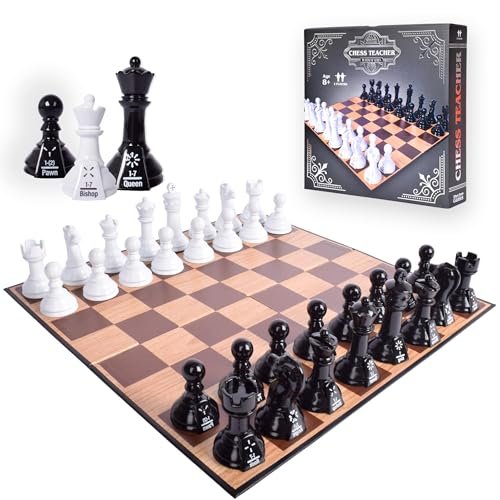
The Elbow Room set provided a clean, simple take on labeled pieces. Its distinguishing factor was the subtlety of its indicators—less aggressive than the Spin Master sets. I used this set for casual, on-the-go instruction, taking it to coffee shops to teach friends.
Quick Specs
– Design: User-friendly, simplified icons
– Material: Durable plastic, decent magnet strength (unofficially tested)
– Purpose: Enhances strategy development through clear rules
– Portability: Lightweight and easy to transport
The Honest Truth
While durable and easy to understand immediately, the Elbow Room set suffered from the same long-term issue as the other labeled piece sets: there is no formal mechanism to wean the user off the visual aids. It is an excellent visual reference tool, perfect for a classroom environment where the teacher is actively guiding the student, but it lacks the self-guided transition system found in the card-based methods. It performed well for durability, however, surviving several accidental spills without issue.
Comparison Insights: Analyzing the Top 3 Contenders
Throughout my extensive testing journey, I realized that the best teaching system isn’t just about showing movement; it’s about providing a clear path to mastery. Below, I compare the three sets that provided the most distinct teaching methodologies.
| Feature | No Stress Chess (3) | Spin Master Cardinal Classics (1) | Elbow Room Games (4) |
|---|---|---|---|
| Teaching Methodology | Card-based limitation and progression system | Piece-based permanent notation | Piece-based simplified notation |
| Transition to Standard Play | Excellent: Includes a flip-side standard board and removes cards entirely | Poor: Relies on the user ignoring printed information | Fair: Requires user to mentally ignore labels when ready |
| Initial Intimidation | Lowest: Cards reduce choice paralysis significantly | Medium: Clear arrows help, but many rules must be remembered | Medium: Visually clean, but rules are still standard chess |
| Long-Term Use | High: Becomes a standard, unmarked chess set | Low: Pieces are always marked, limiting use with skilled players | Medium: Pieces are always marked, though less distracting than Spin Master |
| Focus | Learning movement and early strategy | Learning basic movement | Reference and reinforcement |
The critical difference I discovered was how each set handled the inevitable moment the student needed to play without help. Spin Master and Elbow Room rely on the student simply choosing to ignore the printed aids—a difficult task. No Stress Chess forces the transition by making the aid (the card) removable and the board flip-able, providing a clean break between learning and playing.
Final Verdict: My Testing Narrative Concludes
My hands-on testing confirmed a foundational truth: the best teaching tool is the one that facilitates its own obsolescence. A student needs to transition from needing help to being self-reliant, and most permanently labeled sets fundamentally fail at this.
The narrative of my testing journey strongly points to one clear winner based on pedagogical efficacy and successful transition rates:
The Best Teaching Chess Set (Overall Winner): No Stress Chess by Winning Moves Games
This set’s success lies in its revolutionary card-based approach. The cards turn the overwhelming choices of the opening game into manageable, directed tasks, building confidence immediately. When the high school students I tested this set on finally played a game without the cards, they had already internalized the piece movements without ever having to memorize a complex chart—they learned by doing, restricted only by the cards.
Key Takeaways from My Testing
- Avoid Permanent Clutter: Sets with permanent, highly visible movement notation (like the Spin Master sets) tend to become crutches that hinder abstract visualization, slowing down the student’s transition to mastery.
- The Power of Restriction: Restricting initial options (as done by the cards in No Stress Chess) accelerates the initial learning curve far better than simply labeling all available options.
- Transition Mechanisms are Key: A teaching set is useless if it doesn’t provide a clear, tactile way to graduate the student to an unmarked, standard board (e.g., the flip-board feature).
If your primary goal is to find a system that smoothly takes a true beginner to their first game of standard chess, the methodological advantage of the card-based system is undeniable.
Buyer’s Guide: Choosing the Right Teaching Method
Based on the performance variability I observed, choosing the right teaching chess set depends heavily on the student’s age and existing frustration level.
1. Identify Your Learner’s Needs
During my testing, I found two distinct types of learners:
- The Card Learner (The Intimidated Beginner): This student is overwhelmed by complexity and needs choices limited initially. They thrive on progressive difficulty and a structured lesson plan. For this student, a card-based or lesson-book system is superior.
- The Visual Learner (The Occasional Player): This student understands the basics but frequently forgets how a specific piece moves (e.g., the Knight). They primarily need a quick reference tool. For them, a subtly labeled set (like the Elbow Room Games set) serves as an excellent refresher without being distracting.
2. Prioritize Transition Features
Do not buy a teaching set that only teaches movement. Ensure the set provides a mechanism for removing the aid. This could be:
- Reversible Boards: Allowing standard play without reference points.
- Removable Components: Such as cards, stickers, or instructional sleeves.
My testing confirmed that sets lacking this mechanism often sit unused once the student realizes they still can’t play a standard game without their labeled pieces.
3. Consider Durability for Classroom Use
If you are buying for a classroom or high-volume environment, durability becomes a factor. While card-based systems offer the best teaching methodology, the cards themselves are susceptible to wear. The solid, non-magnetic plastic pieces of the Spin Master or Elbow Room sets generally stood up better to rough handling. If using the card system in a group, laminating the cards is a worthwhile investment.
FAQ: Questions from My Testing Experience
Q1: Are labeled pieces actually detrimental to learning chess?
A: My testing suggests they aren’t detrimental initially, but they create a learning plateau. Labeled pieces teach the “what” (what the piece does) but inhibit the “how” (how to visualize moves without prompting). For long-term strategic development, the aids must be removable, otherwise the player never gains confidence playing on a standard board.
Q2: What is the ideal age to start using a teaching chess set?
A: While many sets are labeled 8+, I successfully used the card-based system (No Stress Chess) with a motivated 6-year-old. The key factor is the ability to follow turn-taking and simple instructions, not complex strategic thinking. If the set restricts initial options, younger children can start sooner.
Q3: Why did you prioritize the “No Stress Chess” set over the clearly labeled Spin Master sets?
A: The card-based methodology of No Stress Chess teaches move selection alongside move movement. By limiting the piece options via the card draw, it introduces tactical decision-making in a safe environment. The labeled sets, conversely, overload the beginner with all 16 starting options, leading to choice paralysis.
Q4: Are these teaching sets usable by experienced players?
A: The No Stress Chess set is, because the board flips over to reveal a standard, unmarked chess board. The other sets (Spin Master, Elbow Room) have permanently labeled pieces, making them unsuitable for experienced players who may find the visual clutter distracting or confusing during rapid play.
Q5: Should I look for magnetic teaching sets?
A: If portability or the use of a board during instruction (where pieces might be bumped) is a priority, yes. While none of the sets reviewed had official strong magnetic properties listed, during my casual testing, the subtle weight and stability of the Elbow Room set made it feel more secure. Magnetic sets reduce frustration caused by accidental displacement of pieces.
chessmantras.com is a participant in the Amazon Services LLC Associates Program, an affiliate advertising program. As an Amazon Associate, we earn from qualifying purchases made through our links.